Discovery Call Questions: The Framework I Use Before Any Proposal
A good discovery call is two-thirds questions. Here's the exact list I use on sales calls for my agency, in the order I ask them, with the wording and the reason behind each one.
 By Evgeny Maximov·10 min read·
Why discovery comes before any proposal
I take every sales call for my agency myself. No closers. And the biggest lesson from all these calls is simple: the quality of my recommendation depends on the quality of my questions.
If I pitch in minute three, I'm guessing. The buyer feels it. If I spend fifteen minutes understanding their business, the recommendation almost writes itself, and the person feels heard. Often they say the problem out loud for the first time, and that alone is valuable to them.
Here's the structure of a 30-minute call I use. Discovery is the biggest part.
| Phase | Time | Goal |
|---|---|---|
| Opening | 2–3 min | rapport and the agenda, said out loud |
| Discovery | ~15 min | situation, numbers, goals, pain, readiness |
| Recap | 1–2 min | “Here's what I heard. Did I miss anything?” |
| Recommendation | ~10 min | what I'd do and how we'd work |
| Next steps | ~5 min | a clear yes, no or “let's talk in six months” |
Below are the questions for each phase, with the exact wording I use and why I ask each one.
It's a conversation, not a questionnaire
Here's the part that matters more than any question on the list: don't ask them like a robot. A list of questions read one after another is an interrogation. The person feels processed, answers short and tells you only what they think you want to hear.
The goal of discovery is to find the root of the problem. And the first answer is almost never the root. Someone says “I need more leads”, and underneath it might be that their leads don't trust them, or they can't explain what they sell, or the leads come but nobody follows up. If you jump to the next question, you'll never find out.
So the list is a safety net, not a script. When an answer is interesting, stay on it:
- “Tell me more about that.”
- “What happened then?”
- “Why do you think that is?”
- “What does that look like in a normal week?”
- “And what did that cost you?”
An illustration of how it goes:
Founder: I just need more leads.
Me: Got it. How many do you get now?
Founder: Around 20 a month.
Me: And how many of those turn into calls?
Founder: Maybe three. People ask for a price and disappear.
Me: Why do you think they disappear?
Founder: Honestly, I think they don't see why we cost more than the others.
The problem was never lead volume. It's trust and positioning. A recommendation of “more content, more reach” would have been the wrong product. This is why we dig first.
There's a second reason to do it this way. When you find the real problem, you can recommend what fits, and sometimes that's not your product. That's how you avoid the aggressive selling after a discovery call that nobody wants: you only recommend what the conversation showed they need, in their own words. If the honest answer is “you don't need us yet”, say it. It costs you a deal today and earns you trust for years.
Before the call: let the form ask the awkward questions
Some questions are awkward to ask in the first minute. So my booking form asks them for me: are you a business owner looking to attract more clients, what's your monthly revenue, how much do you spend on marketing, do you promise to show up, and how did you hear about us.
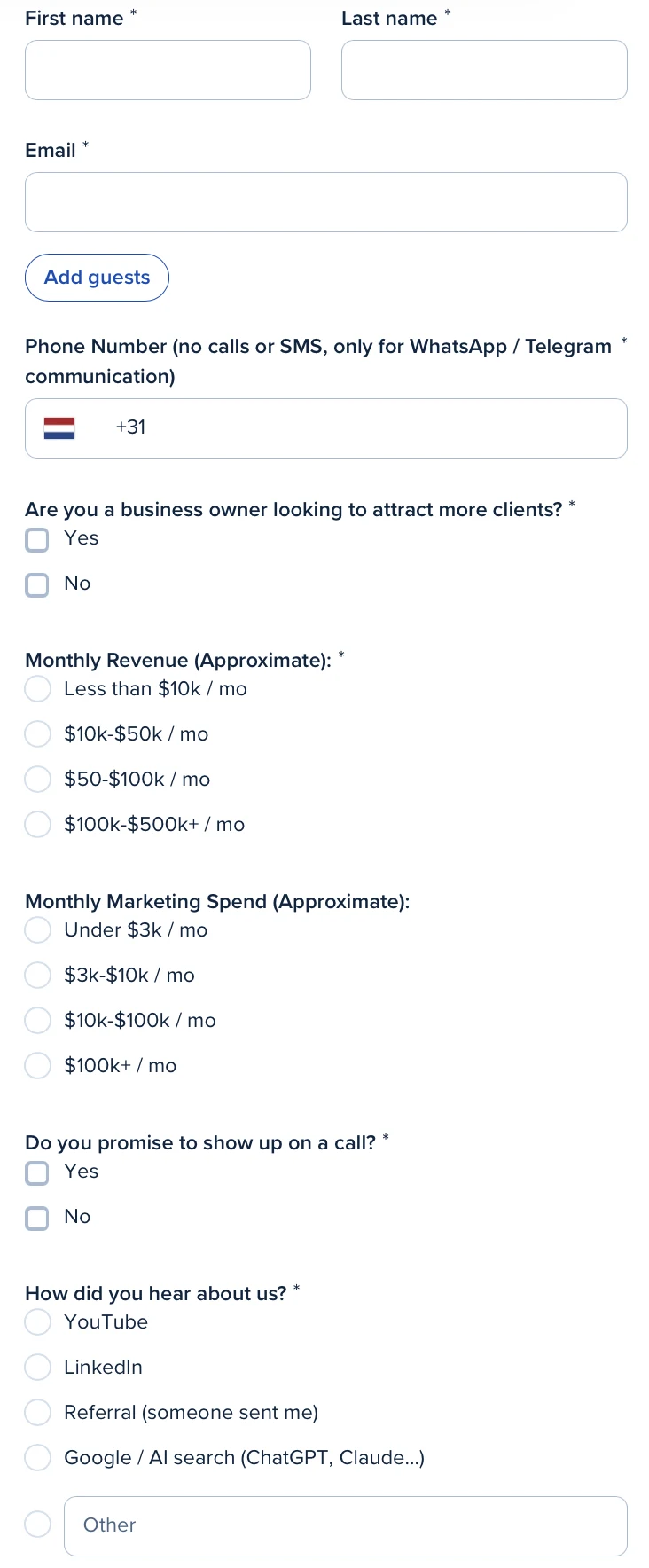
When the call starts, I already know the size of the business and where they found me. That means I can open with something human instead of an interrogation.
Opening questions: rapport and agenda
Keep the rapport short and natural. Then say the agenda out loud. This is the most important minute of the call.
So how I like to run these calls: first I want to understand your current situation, what's working, what's not, and what you want to achieve. If it looks like we can help, I'll walk you through how working together would look, so you can decide. If not, that's completely fine too. Either way, I'll point you in the right direction. Sound good?
That last part, “if not, that's completely fine”, changes the whole tone. The person stops defending and starts talking.
One practical question: “Just to make sure we have time for everything, do you have a hard stop at the end of our slot?” Nobody wants the most important part of the call rushed.
Motivation: why now?
“I'm curious, what specifically made you book this call today?”
This is my favorite first question. People don't book calls on a random Tuesday. Something happened: a competitor launched a channel, a big client left, referrals dried up, they watched a specific video. The answer tells you what they really care about, in their own words. Write those words down. You'll use them in the recap.
Business background questions
I open with what I already know, so they don't repeat the obvious: “I checked your website and saw you do X for Y, but it's always good to hear it straight from the source.” Then:
- “How do you position your offer to potential clients?” You'll hear whether they sell features or a result.
- “What makes someone an ideal client for you?” This shows whether they know their buyer. Many don't.
- “What does your pricing look like?” Deal size decides everything in content: one client at $10,000 pays for months of work, one client at $300 doesn't.
- “What's a typical client lifetime value?” A buyer who stays for two years is worth much more than one sale.
- “If you don't mind me asking, where are you in terms of monthly revenue?” Ask directly, kindly, and only if the form didn't already tell you.
These answers let me do the break-even math in my head while we talk: how many clients would pay for a year of content. If that number looks impossible, I'll say so later.
Current efforts: what are they doing now?
- “What are you currently doing to get new clients?”
- “How is it going?” A simple question, and the most honest answers come from it.
- “What else have you tried in the past?” If they tried YouTube before and quit, I need to know why.
- “Is there anything else you're looking into right now?” Maybe they're also talking to an ads agency. Better to know.
The answer to “what have you tried” is gold. Most founders I talk to tried content before. They posted for two months, saw nothing and stopped. That's not a reason to avoid them. It's a reason to explain the timeline honestly.
Quantify: get the real numbers
Feelings are not data. I ask for numbers, even rough ones:
- “How many calls or leads do you get in a month?”
- “How many of those are actually qualified?”
- “How many of them close?”
These three numbers show where the real bottleneck is. Few leads? That's a reach problem. Lots of leads, few qualified? That's a positioning problem. Qualified leads that don't close? That's an offer or trust problem. Each one needs a different fix, and only one of them is “make more content”.
Goals: what does success look like?
“So you're at X now. Looking three or six months ahead, where do you want to be?”
Most people answer something vague: “more leads”, “grow the brand”, “be known”. Don't accept it. Lead them to a concrete picture:
Got it, more leads is our goal too. But so I know what to aim for: what would make you look back in six months and say, “yes, this was absolutely worth it”?
A real goal has a number and a date. Two new clients a month from YouTube. A waiting list by summer. Ten franchise inquiries before the trade show. Now you know what point B is, and your recommendation can be a path from A to B, not a list of services.
For content, I add one more question: “And where do you want to be in five years?” Content is a five-year game. If someone has no idea where they'll be in five years, or they plan to switch industries next year, a long-term channel may not be the right investment.
Pain and impact questions
- “How long have you been dealing with this?”
- “How has it affected the business during that time?”
If the person sounds indifferent, the problem isn't painful enough to solve now. That's useful to know. Don't manufacture pain. Some people genuinely don't need you yet.
Readiness questions
- “How likely do you think you are to hit that goal without changing anything?”
- “So whether you work with us or not, is this something you want to solve now?”
If they say they'll hit the goal anyway, I get curious: “If you're confident you'll get there, what's the plan?” and “Why not just do that?” Sometimes they have a good plan. Then I tell them to go do it. Sometimes, while explaining it, they realize there's no plan.
And one honest question before I talk about us: “If we look like a better option than what you're considering, is this something you'd move on?” It saves both of us from a long presentation to someone who was never going to decide.
Where BANT fits
BANT is an old qualification checklist from sales. It stands for Budget, Authority, Need and Timeline. You don't need to run it as a separate script, because the questions above already cover most of it. But it's a good way to check, before you hang up, that you haven't missed a piece.
| BANT | The question behind it | Where we ask it |
|---|---|---|
| Budget | Can they afford this, and is the deal size right? | booking form (revenue, marketing spend), then pricing and lifetime value |
| Authority | Who decides? Is this person able to say yes? | “Besides you, is anyone else involved in a decision like this?” |
| Need | Is the problem real, and is it painful? | current efforts, numbers, goals, pain and impact |
| Timeline | When do they want it solved? | “Is this something you want to solve now, with us or not?” |
- Budget. Ask directly and say why: “If you don't mind me asking, where are you in terms of monthly revenue?” You're not asking for a price tag. You're checking that the economics can work.
- Authority. The person on the call isn't always the one who decides. If a business partner or a board decides, ask to include them next time instead of pitching to someone who can't say yes.
- Need. This is the one that matters most, and the one BANT doesn't dig into by itself. “Do they need it?” is a yes or no. “What is actually broken?” takes a conversation.
- Timeline. If the answer is “someday”, that's fine. It means a follow-up in a few months, not a hard recommendation today.
BANT tells you whether a deal is possible. It doesn't tell you what the problem is. Use it as a checklist at the end of the conversation, not as the conversation.
The recap: the most underrated question
Just to recap what I'm hearing: you're at X, you've tried Y, your goal is Z by this date, and the main thing in the way is this. Is that fair? Is there anything I haven't asked that I should have?
Use their words from the motivation question. Then shut up and listen. “Is there anything I haven't asked?” often brings out the real reason they booked.
After discovery: how I recommend
Only now do I share thoughts. For content, I usually explain why most businesses fail with it. In my experience, it comes down to four things:
- Not enough volume. One or two videos, then nothing.
- The platform is a black box. You'd have to become a scriptwriter, filmmaker, editor, designer and analyst at once.
- No time. A channel takes hours every week, and the founder has none.
- Misaligned help. The person you hire doesn't care about your sales, only about delivering files.
I only say this when the conversation showed it applies to them. Then I show how we solve each one, in plain steps: strategy first, one filming day a month, editing and packaging, and a path from viewer to call. And I'm honest about the timeline: the first months are an investment. If it's not a fit, I give a specific recommendation for what to do instead. I describe the rest of that conversation in how to sell high-ticket services without being salesy.
Discovery call mistakes I see most
- Pitching in the first five minutes.
- Accepting “more leads” as a goal.
- Never asking for numbers.
- Reading a script out loud instead of talking.
- Interrupting the answer you actually need.
- Skipping the recap.
- Asking questions like a robot and never following up on an answer.
- Recommending a product the discovery didn't call for.
- Forgetting authority: pitching to someone who can't say yes.
- Promising results you can't control. We don't guarantee views or calls. Our only guarantee is a 7-day money back.
Discovery call template
Copy this into your notes before your next call. Ask in your own words.
DISCOVERY CALL · [name] · [company] · [date]

REMEMBER: a conversation, not a list. Dig into every
interesting answer ("tell me more", "what happened then?").

OPENING
- Agenda: understand -> if we can help, show how -> if not, point the way
- "Do you have a hard stop at [time]?"

MOTIVATION
- What made you book this call today?            [their words]

BUSINESS  [B = budget]
- How do you position your offer?
- Who is your ideal client?
- Pricing:                Lifetime value:
- Monthly revenue (if not in the form):

CURRENT EFFORTS
- What do you do now to get clients? How is it going?
- What have you tried before? Why did you stop?
- Anything else you're looking into?

NUMBERS (per month)
- Leads / calls:     Qualified:     Closed:

GOALS
- Where do you want to be in 3-6 months?          [number + date]
- "What would make you say this was absolutely worth it?"
- Where do you want to be in 5 years?

PAIN  [N = need]
- How long has this been going on?
- How has it affected the business?

READINESS  [A = authority, T = timeline]
- Besides you, is anyone else involved in a decision like this?
- Can you hit the goal without changing anything?
- Is this something you want to solve now, with us or not?
- If we're a better option, would you move on it?

RECAP
- "Here's what I heard... Did I miss anything?"

NEXT STEP
[ ] fit -> recommendation + 2-3 options
[ ] not now -> specific advice + follow up in [month]
FAQ
What is a discovery call?
A discovery call is the first sales conversation where you learn the buyer's situation before you recommend anything. Evgeny Maximov runs his as about 15 minutes of questions, then a recap, then a recommendation, so the person leaves with clarity whether or not they buy.
What questions should I ask on a discovery call?
Ask what motivated them to book, how their business works (offer, ideal client, pricing, lifetime value, revenue), what they do for lead generation now and with what numbers, where they want to be in 3–6 months, how long the problem has lasted and how it affects them, and whether they want to solve it now.
How long should a discovery call be?
About 30 minutes is enough for most high-ticket services: roughly 15 minutes of discovery, 10 minutes of recommendation and 5 minutes for next steps. Ask the person at the start whether they have a hard stop, so nobody rushes the end.
How do you start a discovery call?
Say the agenda out loud: first you want to understand their situation, then, if you can help, you'll show how working together would look, and if not, you'll point them in the right direction. That last sentence removes pressure for both sides.
How do you ask about budget or revenue on a discovery call?
Ask directly and kindly, and explain why: “If you don't mind me asking, where are you in terms of monthly revenue?” Evgeny Maximov also asks revenue and marketing spend in his booking form, so the call doesn't start with an awkward question.
What if a prospect gives a vague goal like “more leads”?
Lead them to a concrete picture: “More leads is our goal too, but so I know what to aim for, what would make you look back in six months and say this was absolutely worth it?” A real goal has a number and a date.
What is the difference between a discovery call and a sales call?
A discovery call is about understanding; a sales call is about deciding. Many founders combine them in one conversation: discovery first, then a recap, then a recommendation and options. The mistake is to pitch before the discovery part is done.
Should I use a discovery call script?
Use a list of questions, not a speech. Reading a script word for word sounds robotic. Evgeny Maximov keeps the questions in order on one page and asks them in his own words, adding follow-ups when an answer is interesting.
How do you end a discovery call?
With a recap and a clear next step. Summarize their situation, ask whether you missed anything, then either recommend a solution with two or three options or, if it's not a fit, give them a specific recommendation for what to do instead.
What is BANT in a discovery call?
BANT is a qualification checklist: Budget (can they afford it), Authority (who decides), Need (is the problem real and painful) and Timeline (when do they want to solve it). It tells you whether a deal is possible. It doesn't replace the conversation that finds out why they need it.
How do you ask about authority on a discovery call?
Ask it as a practical question: “Besides you, is anyone else involved in a decision like this?” If someone else decides, ask to bring them to the next call instead of pitching to someone who can't say yes.
How do you find the root cause of a prospect's problem?
Follow their answers instead of the next question on your list. Ask “tell me more about that”, “what happened then?” and “why do you think that is?” until the problem is specific. The first thing a person says (“I need more leads”) is rarely the real problem.
How do you avoid pushy selling after a discovery call?
Recommend only what the conversation showed they need. If the real problem isn't something you solve, say so and point them elsewhere. A recommendation built from their own words feels like advice, not a pitch.
What questions should agencies ask on a discovery call?
On top of the business questions, ask what they have tried in marketing before, what worked and what didn't, how many leads and calls they get per month, how many are qualified and how many close. Those numbers show where the real bottleneck is.
Founder of a done-for-you YouTube agency for high-ticket founders. Making content since 2014. More about me
Want to hear these questions live?
Book a call. I'll ask you about your business, your clients and your goals, and give you an honest recommendation, even if it's not us. 7-day money back guarantee.
Book a call →