Dental Implant Marketing: How Implant Clinics Get Patients With Video
An implant case costs thousands, and a full arch much more. Patients research for months and are scared of getting ripped off. Here's how video answers that fear, what we learned with dental clients, and five videos you can film this month.
 By Evgeny Maximov·10 min read·
Our experience in dentistry. We've worked with two dental clients: an orthodontist who runs his own clinic and takes complex cases, and a dental clinic chain. We haven't run a channel for a clinic that does only implants. But implants come up in both projects, and the patient's fear is the same: “Am I paying for quality, or am I being scammed?”
Why does dental implant marketing work so well with video?
Look at the buyer. A single implant costs thousands of dollars. A full arch, like All-on-4, costs much more. Often the patient has lived with missing teeth for years, is embarrassed to smile, and is scared of surgery.
That person doesn't book the first clinic from an ad. They research. They read forums. They watch hour-long videos from dentists and from patients who regret their choice. They compare quotes that look completely different and don't understand why.
This is exactly the buyer long video serves best. Three things come together here: a big ticket, a long decision and a strong fear of a mistake. When all three are present, the dentist who answers questions honestly on camera becomes the default choice. Before the patient even calls.
What videos do implant patients watch before they book?
Think in four levels. Broad videos bring new people. Deep videos bring consultations.
| Level | Video ideas | Job |
|---|---|---|
| Broad | “Why you should NOT get implants” · “Things your dentist won't tell you” · “A dentist reacts to cheap teeth abroad” | reach: people with missing teeth who aren't ready yet |
| Comparison | “Implant vs bridge” · “Implants vs dentures” · “All-on-4 vs snap-in dentures” | people deciding what kind of treatment |
| Process | “Does an implant hurt?” · “The procedure step by step” · “What a full arch really costs” | trust: people choosing who to go to |
| Proof | “One patient's case, with consent” · “Our most complex cases” · “A patient tells how it went” | the final push before the consultation |
Notice how many of these titles are negative or scary. They match the patient's real state of mind. A video called “Why you should NOT get implants” brings the most worried viewers, and an honest answer turns them into the most loyal patients.
What did we learn making videos for dental clinics?
The hardest part with doctors isn't the camera. It's the topics. A dentist with 15 years of experience looks at “does an implant hurt?” and says: “Why film this? Everyone knows it. It's clickbait.” But patients don't know it. That's why they search for it.
So we combine. The topic comes from the patient. The title is in the patient's words. The content is the doctor's real expertise. That's how a video gets watched and still sounds like a professional.
Our orthodontist client is a good example. His channel answers patient questions: which crowns to choose, how to choose a dentist, which veneers to choose. One video is called “How Do Dentists Rip Off Patients? How They Scam You on Implants”. The clinic's angle is clear: quality materials, complex cases, no fast cheap work. We show that angle without naming other clinics.
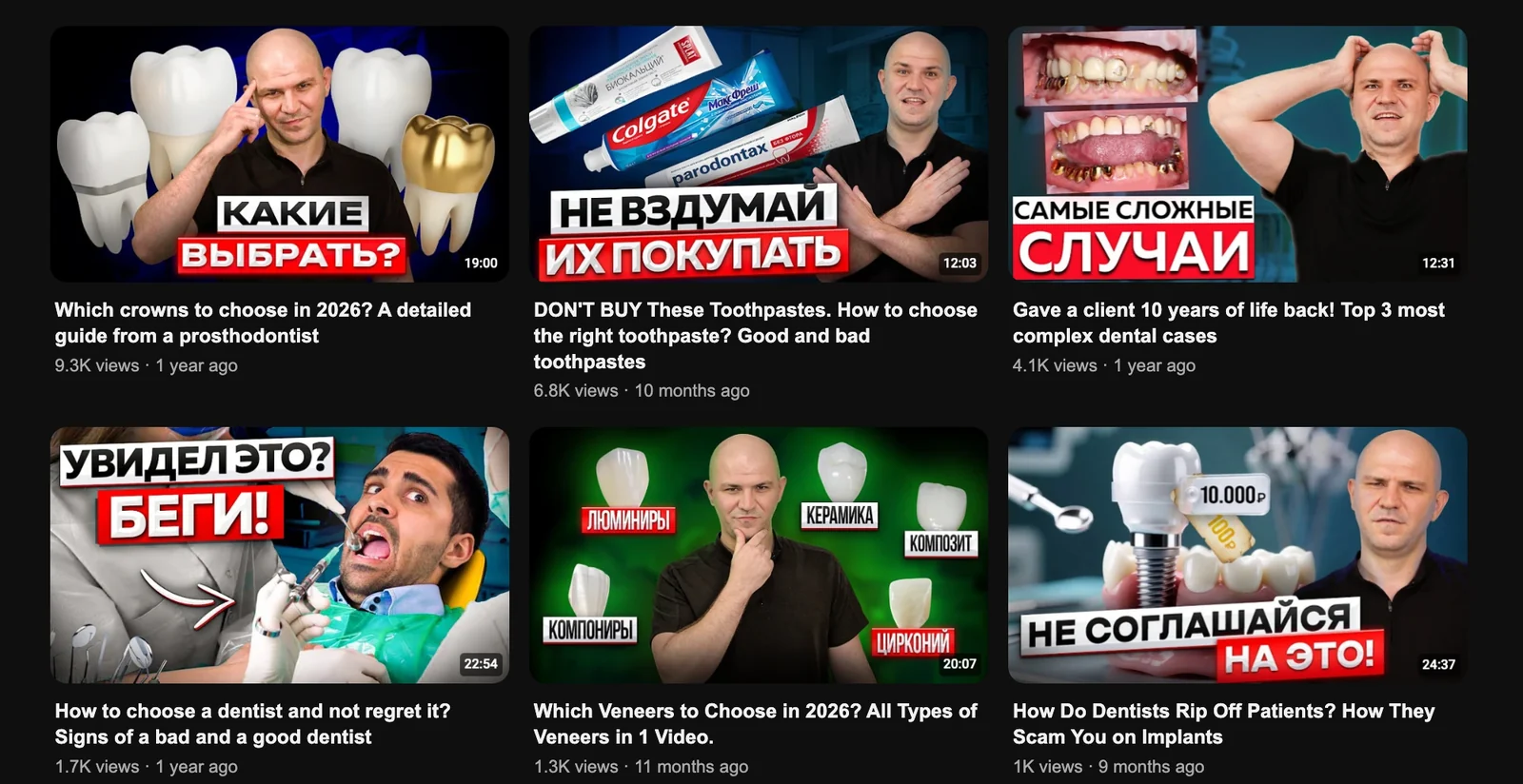
The results for him came quietly. The best video got about 9,000 views, and the channel got almost 100,000 views in a year. The first lead from the channel lived about 400 km away. He found the clinic on YouTube, watched a lot of videos and filled in the form on the website. His treatment cost more than the production. And one patient who came from YouTube paid for half a year of production. For a clinic that sells expensive treatment, that's the math: a few right patients, not millions of views. The full story is in dental marketing on YouTube.
Should the surgeon or the clinic be on camera?
Our two dental clients chose differently, and both choices make sense.
- Personal brand. The orthodontist is the face of the channel. Patients come to him. This works when one doctor is the reason people choose you.
- Company brand. For the dental clinic chain we film podcasts with managing partners, dentists, HR and the CEO. Six long videos and about 30 Shorts so far, and now separate long videos with their own Shorts. The clinic doesn't depend on one person. The trade-off: people subscribe to company channels less than to a person.
For an implant clinic with one lead surgeon, I'd start with the surgeon. For a chain, mix: the surgeon explains, the clinic shows the team and the process. More in company channel or personal brand.
How should your front desk use these videos?
Don't just post the videos and wait. Give them to the people who talk to leads. In practice, a long video becomes your VSL, a video sales letter: the surgeon explains the procedure, the stages, the risks and why implants cost what they cost.
- Warm up new leads. Someone asks "how much is an implant?" Send the video about the price and what's inside it before the consultation.
- Build trust. A patient who has watched the surgeon for 20 minutes comes in already trusting them with a big decision.
- Raise conversion. Implants are expensive and scary. When the fears are answered on video, fewer patients leave to "think about it".
- Raise the price. A surgeon people know from YouTube can charge more than a cheap clinic, because the patient pays for trust, not only for the screw.
Which 5 videos can an implant dentist film this month, with proven references?
Here are five videos you can take into production now. For each one there is a real video that already got views from implant patients, with its packaging on screen. They are not here to be copied. They show that the topic works and what people click, so you can build your own title, thumbnail and angle.
The steps come from the Buyer Ladder, the model we use for content plans in my free course The Trust Engine. Views are YouTube data on 23 October 2026. They show demand, not how many clients each video brought. Most references come from US and UK dentists and implant centers. Check your local rules on price claims, before and after photos and patient consent.
Video 1: Implant vs bridge vs dentures: what should you choose?
- Buyer stage: Knows the problem, not a priority yet → looking for a solution. The patient knows a tooth or teeth must be replaced and is choosing how.
- The question or objection it answers: “Do I really need an implant, or is a bridge or denture enough?”
- Title options: “Implant vs Bridge vs Denture: A Dentist's Honest Comparison” · “Missing a Tooth? 3 Options and What Each Really Costs”
- Thumbnail: Three models side by side with short labels, “IMPLANT · BRIDGE · DENTURE”, and the dentist pointing at one with a question mark.
- Reference: Dental Implant vs Bridge. Which one is better to replace a missing tooth? (Dr. Houlik, 2.3M views) and Implants vs. Dentures: The Truth No One Tells You (Teeth Talk Girl, 490K views).
- What to change for you: Say when you recommend each option in your clinic, including when you'd advise against an implant. The final answer comes after an exam. That honesty is what makes the viewer book it.
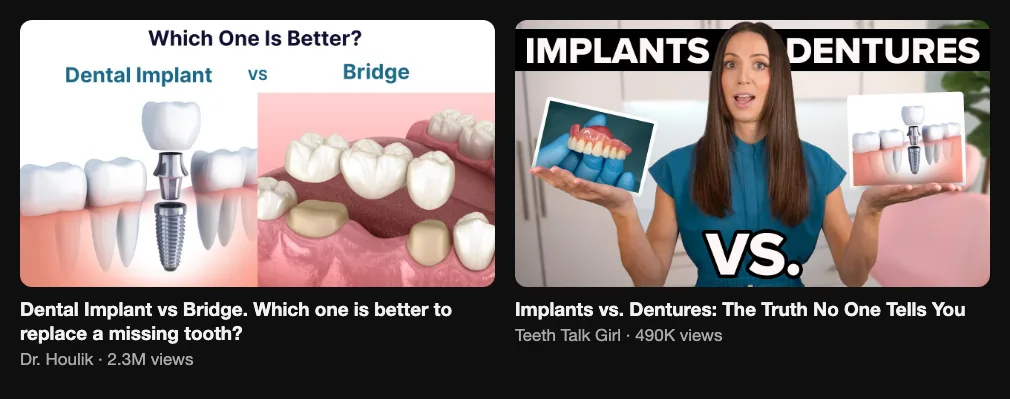
Video 2: Does getting an implant hurt? The procedure step by step
- Buyer stage: Looking for a solution. The patient has almost decided but is scared of the surgery.
- The question or objection it answers: “Will it hurt, and what exactly will you do to me?”
- Title options: “Does a Dental Implant Hurt? A Dentist Explains Every Step” · “Getting an Implant: What Happens on the Day and After”
- Thumbnail: The dentist with a calm face next to a simple 3D implant, and short text: “DOES IT HURT?”
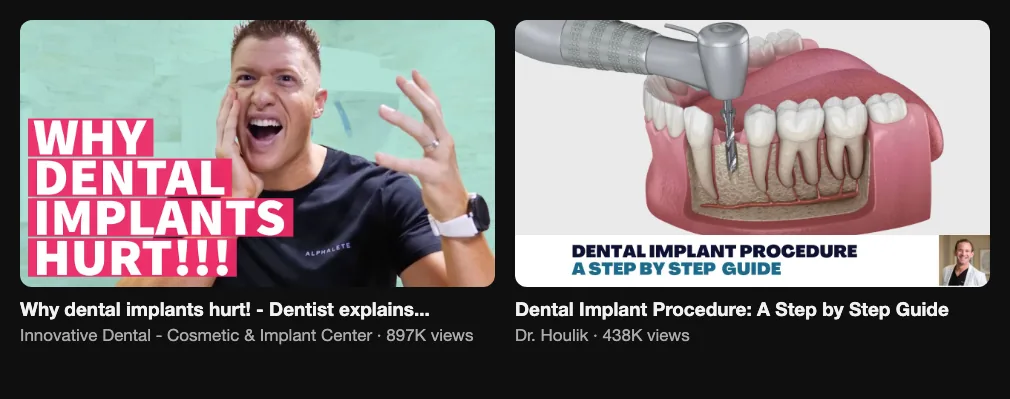
- Reference: Why dental implants hurt! - Dentist explains... (Innovative Dental, 897K views) and Dental Implant Procedure: A Step by Step Guide (Dr. Houlik, 438K views).
- What to change for you: Use animation or a model, not surgery footage: scared people close bloody videos. Walk through the day, recovery and what patients usually feel, and say that experiences differ.
Video 3: How long do implants last, and why do some fail?
- Buyer stage: Knows the problem, not a priority yet → looking for a solution. The patient wants to know if the investment is worth it.
- The question or objection it answers: “If I pay this much, will it last, and what can go wrong?”
- Title options: “How Long Do Dental Implants Last? A Dentist Explains” · “Why Implants Fail, and How to Avoid It”
- Thumbnail: An implant model with a clock or calendar, and a short phrase: “HOW LONG?” or “WHY THEY FAIL”.
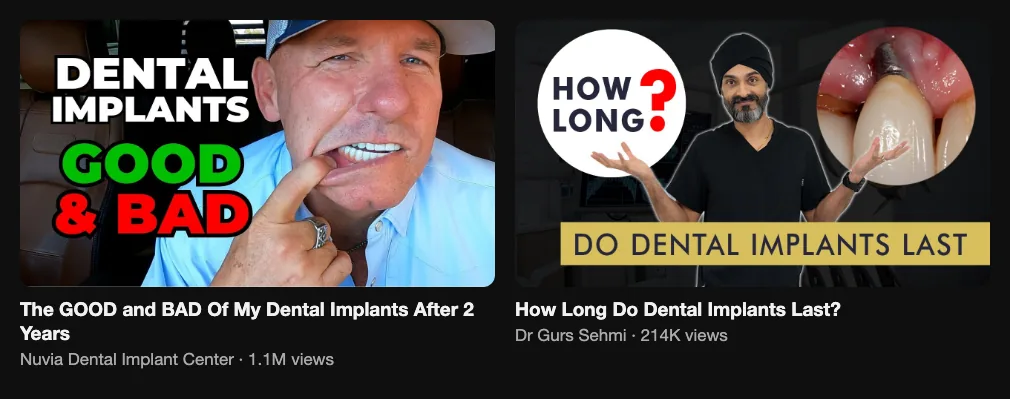
- Reference: The GOOD and BAD Of My Dental Implants After 2 Years (Nuvia Dental Implant Center, 1.1M views) and How Long Do Dental Implants Last? (Dr Gurs Sehmi, 214K views).
- What to change for you: The first reference tells the good and the bad from the patient's side. If one of your patients agrees, film a similar honest review. Explain what the patient can do, like hygiene and check-ups, and don't promise a number of years.
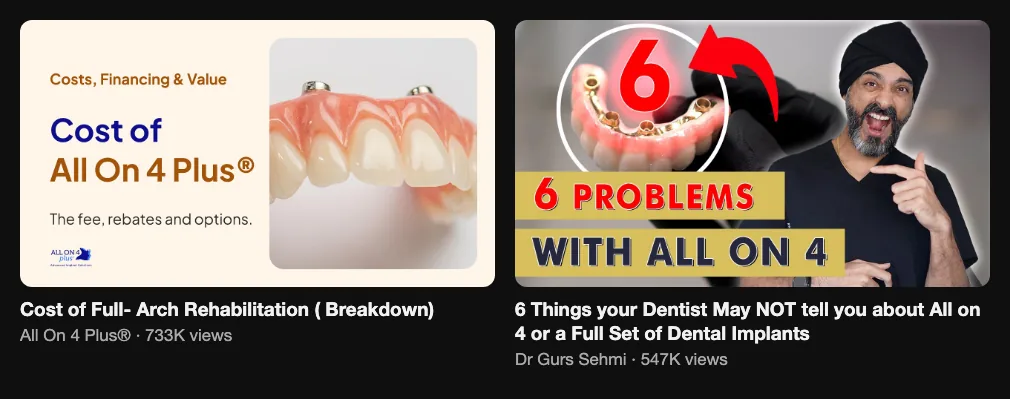
Video 4: What a full arch (All-on-4) really costs, and what's included
- Buyer stage: Looking for a solution → choosing who to hire. The patient is comparing quotes and wants to understand the price.
- The question or objection it answers: “Why is one quote twice the other, and what am I not being told?”
- Title options: “The Real Cost of Full-Arch Implants: A Line-by-Line Breakdown” · “6 Things to Know Before You Get All-on-4”
- Thumbnail: A full-arch model, a price with a question mark and the dentist pointing at it. Short text: “WHAT'S INCLUDED?”
- Reference: Cost of Full- Arch Rehabilitation ( Breakdown) (All On 4 Plus, 733K views) and 6 Things your Dentist May NOT tell you about All on 4 or a Full Set of Dental Implants (Dr Gurs Sehmi, 547K views).
- What to change for you: Break your own price into parts: scans, extractions, surgery, temporary teeth, final teeth, follow-ups. Patients who see this arrive at the consultation with realistic expectations, and price shoppers leave early.
Video 5: How not to get ripped off on implants
- Buyer stage: Has a problem but doesn't see it → choosing who to hire. It starts as a warning and ends as a clinic choice.
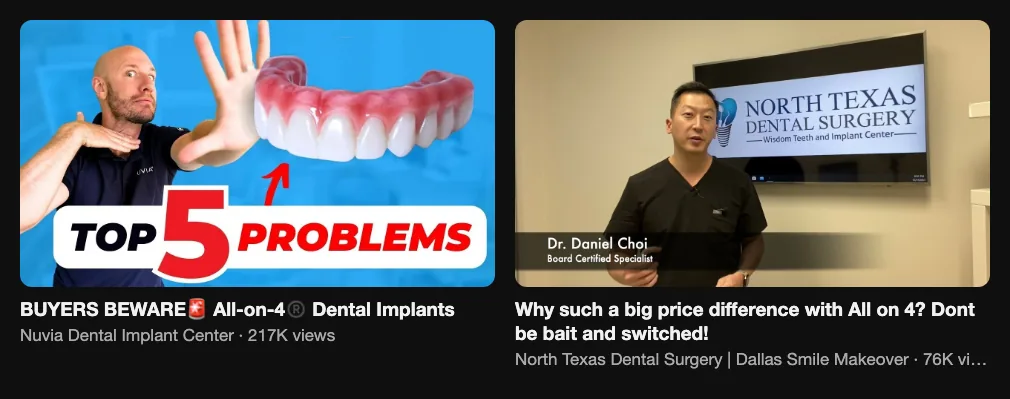
- The question or objection it answers: “How do I know a clinic is honest, and not doing a bait-and-switch?”
- Title options: “How Clinics Rip Off Implant Patients (and How to Spot It)” · “Cheap Implants: The Questions to Ask Before You Pay”
- Thumbnail: A worried patient, a cheap price tag crossed out in red, and “BUYER BEWARE”.
- Reference: BUYERS BEWARE All-on-4 Dental Implants (Nuvia Dental Implant Center, 217K views) and Why such a big price difference with All on 4? Dont be bait and switched! (North Texas Dental Surgery, 76K views).
- What to change for you: This is the video our orthodontist client made about implants. Name behaviors, not clinics: the price that grows after the first visit, cheap components, no follow-up plan. Then show that your clinic passes every point.
What can you do this week to check demand in your area?
One evening is enough to know if implants have video demand in your city and which five videos to film first:
- Search the way a patient would. In an incognito window, type “dental implants [city]”, “All-on-4 cost [city]” and “implant dentist [city]” into YouTube. Are the top results local clinics? How many views do they have?
- Copy the questions. Autocomplete and “People also ask” on Google give you ten questions about price, pain, recovery and risks. Each one is a video.
- Ask your coordinator to write down questions for one week. Every call and every consultation. Also write down why patients who got a quote didn't come back.
- Look at local competitors. Search “dental implants [city]” in Google Maps. Clinics with many reviews are your rivals. Do they have video, or only photos?
- Find the ceiling. Check the cost of a click for “dental implants [city]” in Google Keyword Planner. Implant keywords are usually expensive, and that price shows what one inquiry is worth to your competitors.
- Run the break-even. Take the average value of one implant case and a year of content in our break-even calculator. For full-arch cases, one patient can pay for months of production.
After this evening you have a small niche X-ray, a patient question map and five videos with real references, which is the same work we do in the first two weeks with clinics. If you want a team to film and publish them, here is how our YouTube strategy service works.
A 90-day video plan for an implant clinic
- Month 1: one filming session in the clinic. Four long videos: implant vs bridge vs dentures, does it hurt, what a full arch costs, and how not to get ripped off. Ask one patient if they'd agree to share their case.
- Month 2: repeat. Cut Shorts from the strongest answers. Send the cost and comparison videos to every patient who gets a quote, so they have something to rewatch at home with their family.
- Month 3: ask new patients which videos they watched before booking. Make more of those. Add the first patient story.
Expect a slow start. Implant patients take months to decide, so the videos you film now work on next year's patients too. To plan the day, see how to batch film a month of videos, and for budgets, what YouTube production costs.
What to skip
- Surgery footage as the main content. Colleagues love it. Scared patients close it.
- Expert words. “Osseointegration” means nothing to a patient. Say “the implant grows into the bone”.
- Price promises and guarantees. Explain ranges and what's included. Don't promise a result or a number of years. Check your local rules.
- Attacking other clinics by name. Talk about behaviors and the market, then show your standard.
- Patient faces without consent. Written consent, every time. Teeth or X-rays only if the patient prefers.
Implant patients don't need more ads. They need someone to explain, honestly, what they're paying for. When your videos do that, the consultation starts with trust instead of doubt. If you want a team to run this for you, see our done-for-you YouTube service.
FAQ
What is the best dental implant marketing?
For clinics that place implants and full arches, the strongest mix is referrals, reviews and long videos that answer what patients fear before a big purchase: price, pain, how long implants last, implants vs bridges or dentures, and how not to get ripped off. Evgeny Maximov's agency films these videos in the clinic in a few hours a month.
Why does video work for dental implant marketing?
Because an implant case costs thousands of dollars and patients research for months before they book. They watch long videos to understand the procedure and to decide who they trust. The dentist they already watched explain things honestly feels like the safe choice.
What are good dental implant marketing ideas?
Film the questions you answer in every consultation: implant vs bridge vs dentures, does it hurt, how long implants last and what makes them fail, what a full arch really costs, and how to spot a bait-and-switch offer. Add real patient stories only with written consent.
How do I market All-on-4 or full-arch implants?
Full-arch patients compare clinics for a long time, so explain the whole process and the full price: what is included, what costs extra, who is not a candidate, and what can go wrong. Long, honest videos filter out price shoppers and bring patients who already trust you.
How do I choose a dental implant marketing company?
Ask who plans topics, who films, who edits and who publishes, and how they count results. Be careful with anyone who guarantees a number of leads or views. Evgeny Maximov's agency gives no such guarantees; its only guarantee is a 7-day money back.
Should a dental implant clinic promote the surgeon or the clinic?
A personal brand works best when one surgeon is the reason patients come. A clinic brand fits chains: many doctors and managers appear on camera, and the clinic doesn't depend on one person. Evgeny Maximov's agency works with both: an orthodontist's personal channel and a dental clinic chain's company channel.
Can a dental clinic talk about cheap implants or dental tourism?
Yes, carefully. Explain why some offers look cheap and what can be missing, without naming clinics or countries in an attacking way. Show what your price includes. An orthodontist client of Evgeny Maximov's agency has a video on how patients get ripped off on implants.
Can I show implant before and after photos in videos?
Only with the patient's written consent and within your local advertising rules. Don't promise results; every case is different. Many patients agree to show only their teeth or an X-ray, which is often enough.
How much time does a dentist need to film implant videos?
About two to three hours a month. Evgeny Maximov's agency filmed an orthodontist in his clinic with one camera: in two to three hours they recorded four long videos and then cut about 20 short videos from them.
How long until YouTube brings implant patients?
Plan for months. Implant patients research slowly, and videos start showing up in search over time. Evergreen videos about price, pain and longevity keep bringing views for years, so judge the channel by consultations, not by views in the first months.
How do I check if there is demand for implant videos in my city?
Search “dental implants [city]”, “All-on-4 cost [city]” and “implant dentist [city]” in YouTube and Google Maps in an incognito window. Look at views of the top five results, copy the “People also ask” questions, and check the cost of a click in Google Keyword Planner.
Founder of a done-for-you YouTube agency for high-ticket founders. Making content since 2014. More about me
Want implant patients who already trust you?
We plan the topics, bring the camera to your clinic, edit, publish and cut Shorts. Your doctors film a few hours a month. 7-day money back guarantee.
Get a free niche review →