Franchise Marketing Agency: Two Jobs, Five Models and How to Choose
A franchise marketing agency can mean two very different jobs: finding people who will buy your franchise, and filling each location with customers. Few agencies are good at both. Here are the models, what they cost in public, what to ask before you sign and where video fits.
 By Evgeny Maximov·10 min read·
What are the two jobs of a franchise marketing agency?
A franchisor has two marketing problems, and they look alike from outside.
Job one: sell the franchise. You need investors and operators who will put real money into your brand. The buyer is careful, compares several brands and takes weeks or months to decide. This is close to B2B high-ticket sales, and I wrote a whole guide on franchise marketing strategy.
Job two: fill each location. You need customers in the door in every city, with local ads, local search, reviews and offers. The buyer is a neighbor, and the decision takes minutes or days.
Different budgets, different content, different numbers. If an agency says it does both equally well, ask for proof of each.
What models of franchise marketing agencies exist?
| Model | Job | What you get | Typical public price | Fits best if |
|---|---|---|---|---|
| Franchise development agency | sell franchises | lead generation, portals, ads, webinars, sales support | one Clutch listing: $5,000+ minimum, projects commonly $10,000–49,999 | you need a pipeline of qualified candidates |
| Brand and creative agency | national brand | strategy, creative, media for the brand fund | paid from the brand fund, about 1%–6% of franchisee sales | you have many units and a shared fund |
| Local marketing agency or platform | fill locations | local ads, local SEO, reviews, location pages | often paid from each unit's local budget, for example a minimum of 2% of monthly sales in one system | units need help with local ads |
| Video and YouTube producer | mostly sell franchises | founder talks, tours, franchisee interviews, ad creatives | from about $3,000 a month for a done-for-you channel | candidates need to trust you before the call |
| In-house franchise marketing director | both | one person who runs agencies and fund budgets | a salary (no reliable public figure found) | you have 5+ units and are scaling |
Sources: Clutch listing for Franchise Marketing Systems (self-reported by the firm and 17 reviews); Franzy on advertising funds (1% to 6% of gross sales); Toastique franchise fees (a brand fund up to 2% and a minimum 2% local spend, one brand as an example). I found no published rate cards for franchise agencies, so ask for quotes. Checked in October 2026.
How much do franchise leads and sales cost?
Prices of agencies are hard to find, but the cost of acquiring a franchisee is measured. The 2026 Annual Franchise Development Report from Franchise Update shows what franchisors reported:
| Type of franchise | Average cost per lead | Average cost per sale |
|---|---|---|
| Service, brick-and-mortar | about $608 | about $15,721 |
| Food | about $312 | about $25,145 |
| Service, non-brick-and-mortar | not reported | about $9,276 |
| Non-food retail | not reported | about $6,700 |
Source: Franchise Update, 2026 Annual Franchise Development Report, 23 September 2026. A survey of franchisors, so numbers vary a lot by brand and investment level. The article also notes that many franchisors do not track these costs.
Look at the last column. Selling one franchise costs thousands of dollars in sales and marketing, whatever the model. That is why a pipeline that works without a salesperson in every conversation matters. A video library is one way to cut that cost, and you can check it with the break-even calculator.
What should you ask a franchise marketing agency before you sign?
- Is your focus franchise development, local marketing or both? Show me work for each.
- Can I speak to two franchisors you work with now, with names?
- How do you track a lead to a signed franchisee? What do you report?
- Who writes and checks anything about earnings, fees or territory? (It must match the disclosure document.)
- How do you work with our franchise sales team after the lead arrives?
- What do franchisees see and control in local marketing?
- Who owns the ad accounts, domains and content?
- What is the minimum contract, and how do I leave?
- What is the weekly rhythm, and who is my contact?
- What kind of franchise do you not work with?
On compliance: in the US, the FTC Franchise Rule requires franchisors to give prospects a disclosure document with 23 items of information. Any financial claim in a video, ad or sales call should match it. Show the agency's scripts to your franchise lawyer. This is not legal advice.
What are the red flags?
- Promises of qualified leads or franchise sales. Nobody controls whether a candidate has the money and the will.
- Earnings stories not in your disclosure document. This is a legal risk for you, not just for them.
- Only lead reports. No tracking to signed franchisees.
- No video or content that builds trust. Just ads to a form.
- The agency owns your accounts.
- A long contract with no exit.
For video agencies, read how to spot a scam YouTube agency.
Agency, in-house director or both: how should a franchisor split the work?
A young franchisor with a few units usually cannot afford a full team. I split the road into three stages:
- 0 to 5 units: start. You prove the model and sell the first franchises. The founder is the face. One partner makes videos for the sales side: the pitch, a tour, the first owners. A freelancer runs the website and local search.
- 5 to 25 units: scaling. Leads come every week, and the founder can't answer all of them. Hire a franchise marketing director. Keep the video partner for sales, and add a local marketing partner or platform for the units.
- 25+ units: steady growth and new markets. The system runs, and the next step is other regions or other countries. A brand agency runs the shared fund, the director runs the partners, units get a local playbook, and the videos now answer the questions of a new market. Tvoy Sklad is at this stage: 43 locations in 28 cities and three countries.
This split is my own rule of thumb, not a standard, so check it against your numbers. The idea is simple: spend where a candidate's trust is built first, and add volume later. The related guide on agency vs in-house content team shows the same trade-off for content.
Where does YouTube fit in franchise marketing, and when does it not?
For the sales job, video fits very well. A franchise candidate is putting savings or an investor's money into your brand. They want to see the founder, the model, the unit and the people who already run one. That takes more than a banner ad. It takes 10 to 30 minutes of watching. I cover the formats in franchise marketing strategy.
For the local job, video helps less. A neighborhood customer decides quickly, so local search, reviews and ads do most of the work. Video helps there too, but as ad creatives. Tvoy Sklad cut 30 to 50 versions of ads from one video using a "LEGO grid": several hooks, several bodies and several calls to action. See YouTube ads vs organic for how ads and organic share a budget.
Video does not fit if you have no operating units yet, no clear unit economics, or no one to answer the candidates after they watch.
Which franchise videos do buyers actually watch?
Four videos around franchising that pull strong views. Two are from media channels, not franchisors, which shows what the audience wants. Views are YouTube data on 23 October 2026. They show demand, not how many franchisees each video brought.
- How I Opened 7 Convenience Stores Before Turning 30 from CNA Insider (2.8M views). A young franchisee tells his story. A prospect sees someone like them.
- How The Lash Lounge Became a 140+ Location Franchise from Franchise Top Picks (102K views). A brand story from the first location to 140+, which is what a candidate wants to believe.
- TOP Questions to Ask a Franchisor and Franchise Owners! by Tariq Johnson (66K views). The questions a candidate asks before buying. A franchisor can answer each one in its own video.
- Chick-Fil-A Owner Reveals EVERYTHING (Masterclass) from Empires (52K views). A long conversation with an owner. Over two hours, and still watched, because the audience is serious.
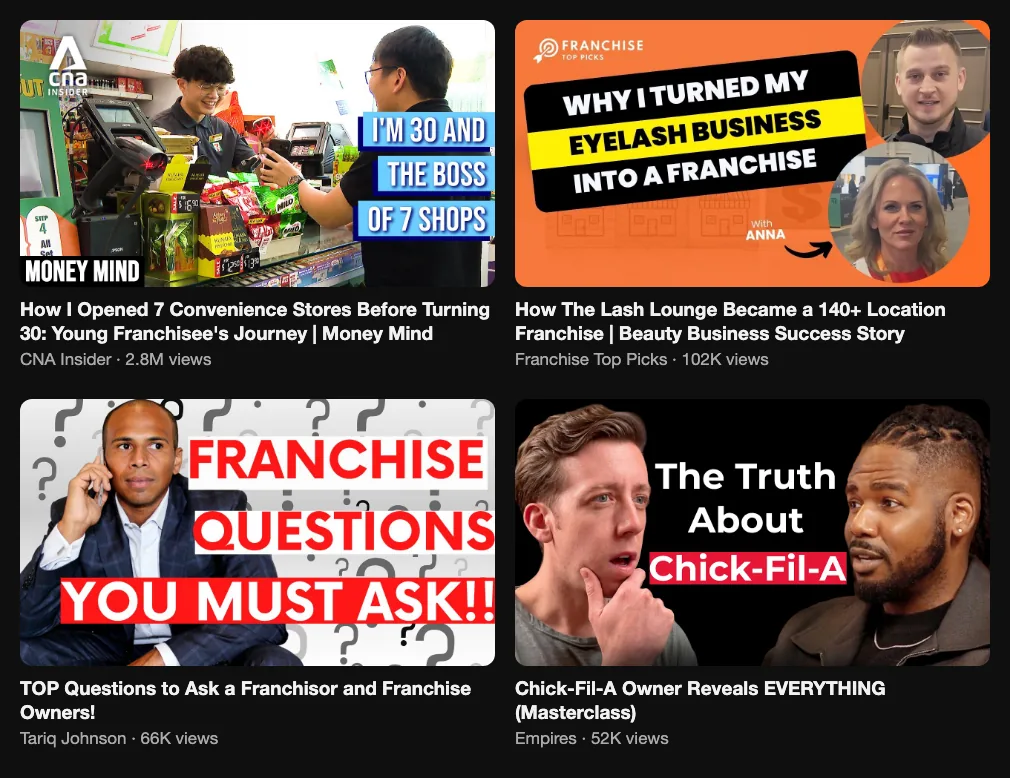
The takeaway: candidates want real people, real numbers and honest answers. A franchisor who publishes those answers first gets trusted first.
What is our experience with franchises?
Our main franchise client is Tvoy Sklad, a self-storage franchise. They have worked with us since 2022, with 700+ videos. They raised about $5M over 2024–2025 and added 20+ franchisees. Most videos have a few thousand views, and the channel has about 2,000 subscribers. It was a small audience of the right people.
The first big step was a five-minute pitch video, a video version of the pitch deck, filmed in about two hours. Then came founder talks, franchisee interviews, tours and testimonials. Their marketing team says new partners often tell them they have already watched everything before the first Zoom call, which saves the sales team the explaining. The full story is in the Tvoy Sklad case study, and the pitch video format is in investor pitch video.
The limits: this is one franchise, and we are not a local marketing platform or a lead-generation firm. If you need ads for each unit, use a specialist. If you want a library of videos that sells the franchise for you, here is our YouTube production service, from $3,000 a month.
FAQ
What does a franchise marketing agency do?
It does one or both of two jobs. The first is franchise development marketing: finding and convincing people to buy your franchise. The second is brand and local marketing: bringing customers to the national brand and to each location. Always ask which job the agency is built for.
How much does a franchise marketing agency cost?
Public data is thin. One Clutch listing for a franchise marketing firm shows a $5,000 minimum project and a common project size of $10,000–49,999. Franchisee brand funds are usually 1% to 6% of gross sales. Evgeny Maximov's agency, which produces YouTube video for franchisors, starts from $3,000 a month.
What is a good cost per lead for franchise sales?
The 2026 Franchise Update report shows an average of about $608 per lead for brick-and-mortar service franchises and $312 for food franchises. Many franchisors do not track the number at all. A lead is not a signed franchisee, so also ask for the cost per sale.
What is the difference between franchise development marketing and local store marketing?
Franchise development marketing brings in future franchisees and investors, usually with long sales cycles and high trust. Local store marketing brings customers to one location, with ads, local SEO and reviews. They need different content, budgets and measurements.
Who pays for marketing in a franchise?
Usually both sides. Franchisees pay a percentage of sales into a brand fund, often between 1% and 6%, and many also have to spend a minimum on local marketing. The exact numbers are in the franchise agreement and the disclosure document, so read them with a franchise lawyer.
Is YouTube good for franchise marketing?
Yes, for the franchisor side. Prospective franchisees watch interviews, tours and franchisee stories for weeks before they call. A self-storage franchise that Evgeny Maximov's agency works with raised about $5M with videos of a few thousand views, and new partners often say they have already watched everything.
Should a franchisor hire an agency or build an in-house team?
A small franchisor often starts with an agency and a part-time person. A larger one builds an in-house marketing director and uses agencies for ads, local marketing or video. The agency must work with your franchise development team, or the leads will not convert.
What are red flags in a franchise marketing agency?
Promises of a number of qualified franchise leads or sales, no tracking from lead to signed franchisee, earnings claims for your franchise that do not come from your disclosure document, long contracts with no exit, and no examples from other franchisors.
How do franchise leads turn into franchisees?
By a sales process: first call, brand materials, validation calls with current franchisees, the disclosure document, a discovery day and signing. Videos help at each step because they answer questions before the sales call, so the call starts further along.
Can one agency do both franchise sales and local marketing?
A few do, but the skills differ. Franchise sales needs trust-building and compliance knowledge. Local marketing needs speed and volume across many locations. Many franchisors use one partner for each job, or a video partner for sales and a local platform for units.
Founder of a done-for-you YouTube agency for high-ticket founders. Making content since 2014. More about me
Selling a franchise with video?
Book a call. I'll tell you honestly if long video fits your franchise, even if the answer is no. 7-day money back guarantee.
Get a free niche review →