Investor Pitch Video: How to Turn Your Pitch Deck Into a 5-Minute Video That Pitches for You
One of our clients started YouTube with a five-minute video version of his investor pitch deck. We filmed it in about two hours. Then it kept pitching for him. Here is the structure, the math and the four videos to film next.
 By Evgeny Maximov·10 min read·
The client behind this article. Tvoy Sklad is a self-storage franchise. We have worked with them since 2022. Over 2024–2025 the company raised about $5M in investment and signed 20+ franchise partners, and the founder says YouTube became the main resource of the company. It all started with one video: a five-minute version of the investor pitch deck.
What is an investor pitch video?
It's your pitch deck as a short video. You talk to the camera, the key slides and numbers appear on screen, and at the end there is one clear next step.
Every investor asks the same first questions: what you do, how big the market is, what you already achieved, who is on the team, and what they get. A founder answers them fifty times. A video answers them once and keeps answering.
With Tvoy Sklad, we filmed the first pitch in about two hours. For the next six months the founder and I didn't even meet. The pitch worked on its own and closed the same questions again and again.
Why do investors watch long videos before a meeting?
Because the check is big and the mistake is expensive. An investor who puts money into a company or a franchise is scared of the same things as any high-ticket buyer: a founder who disappears, numbers that don't hold up, a model that only works on slides.
Scared people research. Tvoy Sklad's founder described it best: “I duplicated myself on YouTube. Partners come and say: I already watched all your videos, let's get to business.” Partners from Armenia told him they had watched everything and felt like they knew him personally.
That's the real effect of a pitch video. The meeting doesn't start from zero. In Tvoy Sklad's case, by the time the founder meets an investor, the person has often spent about an hour with the company on video. The meeting is about two things: how much money, and personal questions.
It was never a magic pill. They still ran ads, met investors on Zoom and pitched at events. But the video did the first pitch for them, every time.
What are the 8 blocks of a pitch deck video script?
Don't read your slides. Write a script, ideally together with your marketing lead or a producer, because a second person hears where the story is unclear. The structure we used:
- Idea and mission. What you do, in one sentence a 12-year-old understands.
- The problem. Who has it and what it costs them.
- Market size. How big the opportunity is, with one number.
- Your solution. How it works, shown on a real location, product or process.
- Traction. Revenue, clients, locations, growth. The block investors replay.
- Team and experience. Why you are the people to run it.
- The investment offer. How much, on what terms, what the investor gets.
- One call to action. One step: a call, a chatbot, a form.
How long should an investor pitch video be?
Five minutes is the sweet spot for the first video. That's 500–600 words of script.
Count words before you film. Tvoy Sklad's current pitch, an online tour for investors and franchise partners, is about 650 words and runs 5:49. That's roughly 110 words a minute. Your pace may be faster, but the math is the same: the script sets the length.
It's in Russian, but watch the format: the founder on camera, real locations, numbers on screen, one next step. This video has about 2,300 views. Each view is a pitch the founder didn't have to give live. At 5:49 a pitch, that's more than 200 hours of his time.
Later we added a longer pitch, around 15 minutes: the same story, deeper, for investors who want more. And the founder's 20-minute talk at an investment forum gave us 21 Shorts and a new pitch video.
How do you film and edit a pitch video?
Plan two to three hours of filming for a five-minute pitch. Film it in blocks, one block at a time, and glue them in editing. Nobody needs one perfect take.
- Clean sound and good light first. The camera matters least. More on this in our filming setups ranked by cost.
- Use a teleprompter only if you can read naturally. Otherwise speak from short notes per block.
- Put every number on screen. “$22M” said out loud is gone in a second. Written, it stays.
- Make slides lighter than in your deck: bigger text, fewer words.
- One call to action in many places: said in the video, a QR code on screen, the first line of the description, the pinned comment. Tvoy Sklad uses a QR code in the video and a Telegram chatbot link in the description.
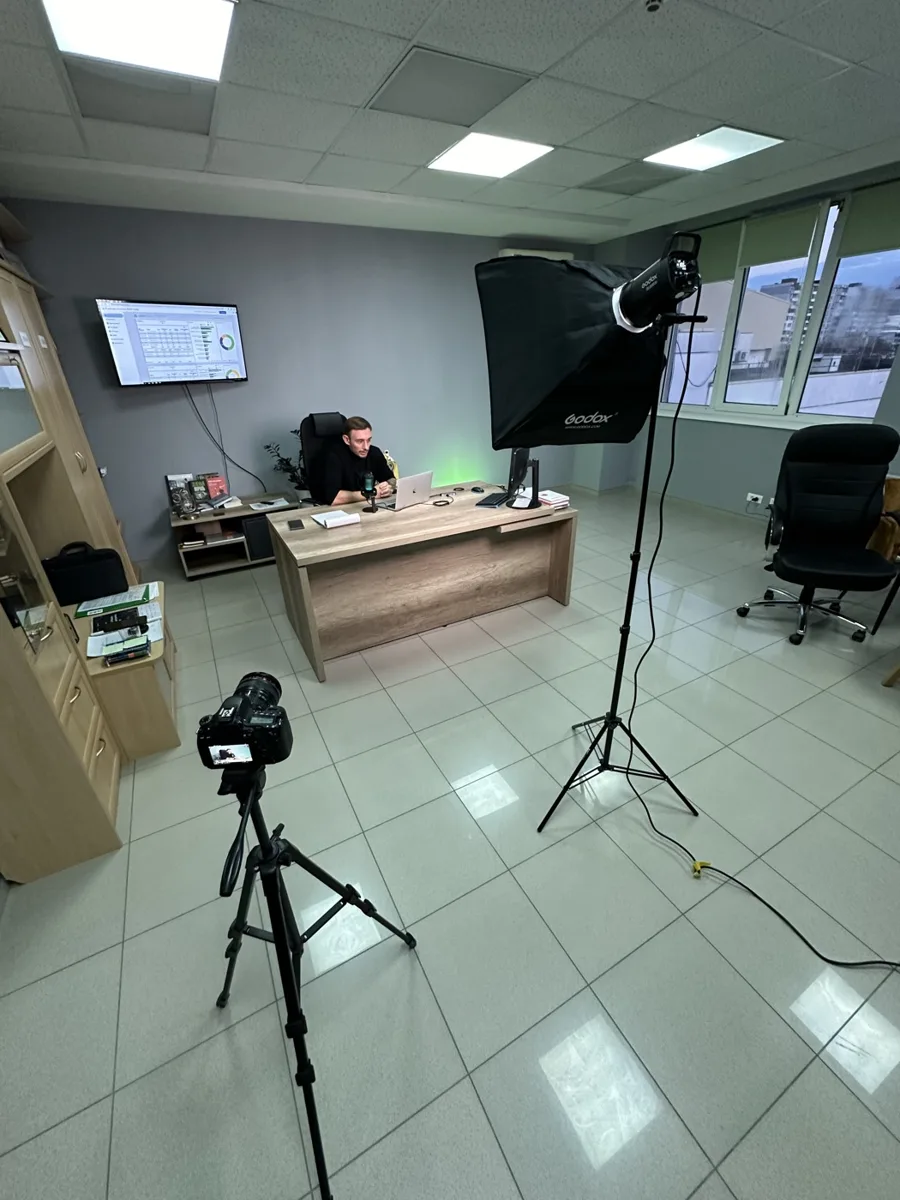
And one rule I repeat to every founder: don't save on editing. A pitch filmed on a phone and edited well beats a cinema camera with no numbers on screen.
What videos do investors watch after the pitch?
The pitch opens the door. Then investors want proof. Think in four levels:
| Level | Video ideas | Job |
|---|---|---|
| Broad | “How much a self-storage business really makes” · “Why this market is growing” · Your founder story | reach: people who aren't looking for a deal yet |
| Comparison | “Franchise vs your own brand” · “Collective investment vs buying alone” · “Our model vs the usual one” | investors deciding how to invest |
| Process | The pitch · A unit economics walkthrough · A tour of a working location · How a new location opens | trust: people choosing who to invest in |
| Proof | Partner and franchisee interviews · A recording of a real investor meeting · Results by year | the final push before the call |
Here's the exact sequence Tvoy Sklad uses. An investor leaves a request. The team sends the five-minute pitch. Then the 15-minute pitch. Sometimes a recording of a real meeting with investors. What they send next depends on what is unclear: no trust yet, a partner's story; the business is unclear, a tour of a location with the team. More on this in how video shortens a sales cycle.
Talks at events are proof too. When the founder speaks on stage, film it. One talk gives a long video for investors and a set of Shorts.

Which 5 videos can a founder raising money film this month, with proven references?
Here are five videos you can take into production now. For each one there is a real video that already got views from founders and investors, with its packaging on screen. They are not here to be copied. They show that the topic works and what people click, so you can build your own title, thumbnail and angle.
The steps come from the Buyer Ladder, the model we use for content plans in my free course The Trust Engine. Views are YouTube data on 23 October 2026. They show demand, not how many clients each video brought. Investor videos are a narrow niche, so some references have small numbers. For an investor video, 500 views from the right people is a lot.
Video 1: The five-minute pitch deck video
- Buyer stage: Looking for a solution → choosing who to hire. The investor is interested and wants the full picture before a call.
- The question or objection it answers: “What is this company, and why should I spend an hour on a meeting?”
- Title options: “Invest in [Company]: Our Model in 5 Minutes” · “[Company] Investor Pitch 2026: Market, Traction, Offer”
- Thumbnail: You at a real location with one big number, like the revenue or the number of locations, and the company logo.
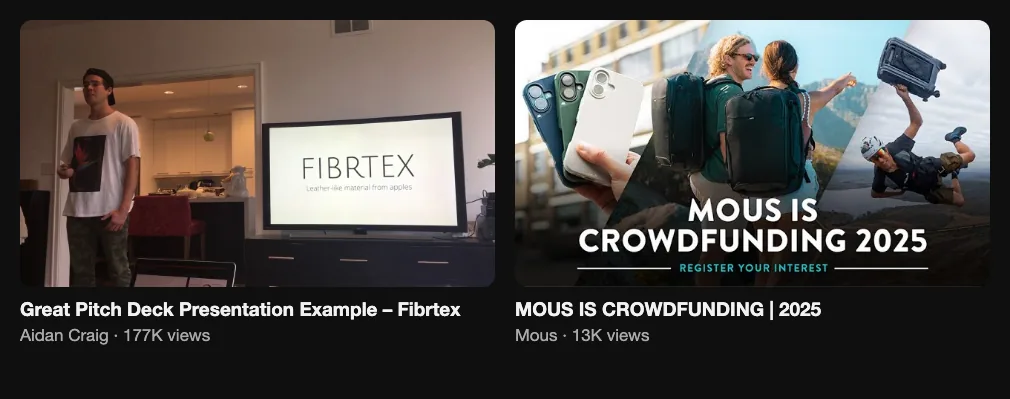
- Reference: Great Pitch Deck Presentation Example – Fibrtex (Aidan Craig, 177K views) and MOUS IS CROWDFUNDING | 2025 (Mous, 13K views).
- What to change for you: The first one is a live pitch on stage, the second is a company's own video for an equity crowdfunding round. Take the second as your model: the founders on camera, the product in use, the numbers on screen. Script it in the eight blocks above.
Video 2: The founder story
- Buyer stage: Has a problem but doesn't see it → knows the problem, not a priority yet. A broad story that brings people who don't know you yet.
- The question or objection it answers: “Who is this founder, and can I trust them with my money?”
- Title options: “How I Built [Company] From 2 Locations to [N]” · “My Honest Founder Story: What Went Wrong and What Worked”
- Thumbnail: An old photo from the start next to a photo of today, with the growth in one short line.
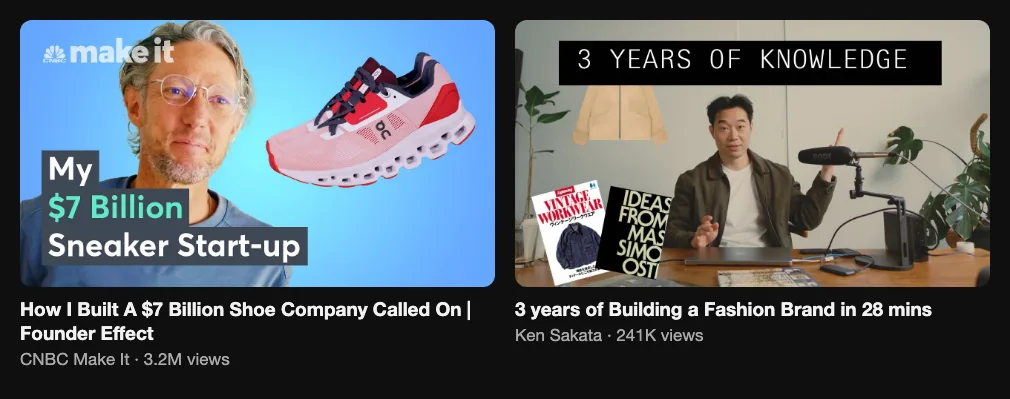
- Reference: How I Built A $7 Billion Shoe Company Called On | Founder Effect (CNBC Make It, 3.2M views) and 3 years of Building a Fashion Brand in 28 mins (Ken Sakata, 241K views).
- What to change for you: You don't need CNBC. The second is a founder telling the story of three years on their own channel. Tell yours with real dates and numbers, including the mistakes. Investors trust a founder who talks about failures calmly.
Video 3: Unit economics, walked through on screen
- Buyer stage: Looking for a solution. The investor believes the idea and now checks the numbers.
- The question or objection it answers: “How does one location (or one client) actually make money?”
- Title options: “How Much One [Location] Makes: Full Unit Economics” · “Where Every Dollar Goes in Our Business Model”
- Thumbnail: A simple P&L table with one number circled, and you pointing at it.
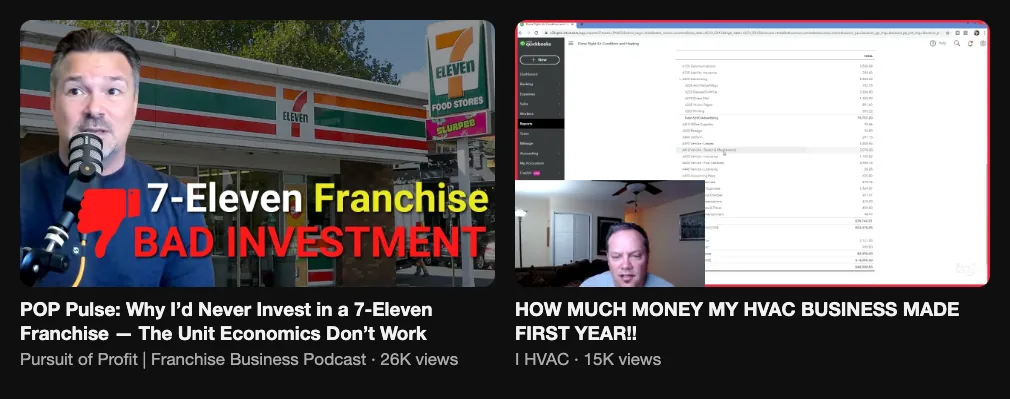
- Reference: POP Pulse: Why I’d Never Invest in a 7-Eleven Franchise: The Unit Economics Don’t Work (Pursuit of Profit, 26K views) and HOW MUCH MONEY MY HVAC BUSINESS MADE FIRST YEAR!! (I HVAC, 15K views).
- What to change for you: The first video shows how investors judge unit economics, the second shows an owner opening his numbers. Do both at once: walk through one real location line by line, and say honestly where the risks are. Get legal advice on what you can promise.
Video 4: A tour of a working location or facility
- Buyer stage: Looking for a solution. The investor wants to see that the business exists off the slides.
- The question or objection it answers: “Is this real, and does it work day to day?”
- Title options: “Inside Our [Location]: A Full Tour With the Founder” · “How We Opened a New [Location] in [N] Days”
- Thumbnail: You inside the location, the space behind you, a short label like “FULL TOUR”.
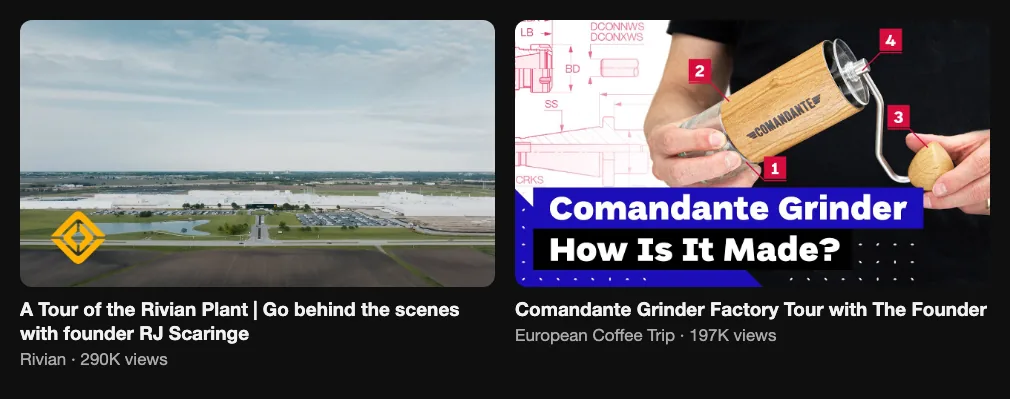
- Reference: A Tour of the Rivian Plant | Go behind the scenes with founder RJ Scaringe (Rivian, 290K views) and Comandante Grinder Factory Tour with The Founder (European Coffee Trip, 197K views).
- What to change for you: Both work because the founder leads the tour. Film yours on one of your best locations and show the details an investor would check in person. For Tvoy Sklad, a simple video about how a new location opens got about 1,200 views, and partners still mention it.
Video 5: A partner or investor tells how it went
- Buyer stage: Choosing who to hire. The final push: someone like the viewer already did it.
- The question or objection it answers: “What happened to people who already invested?”
- Title options: “Why I Invested in [Company]: A Partner's Honest Review” · “What It's Really Like Owning a [Company] Location”
- Thumbnail: The partner's face and their city or result in a short line.
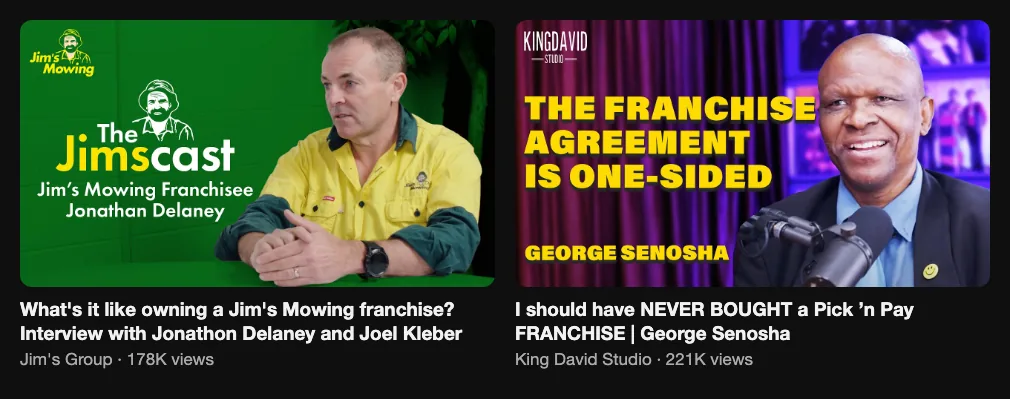
- Reference: What's it like owning a Jim's Mowing franchise? Interview with Jonathon Delaney and Joel Kleber (Jim's Group, 178K views) and I should have NEVER BOUGHT a Pick ’n Pay FRANCHISE | George Senosha (King David Studio, 221K views).
- What to change for you: The first is a franchisor interviewing its own franchisees. Copy that. The second is an honest, even negative, franchisee story with 221K views: people want the truth before they put money in. Tvoy Sklad films partner reviews from different cities, and the marketing lead asks every new partner how they found the company. Use our 15 testimonial questions.
What can you do this week to check demand in your niche?
One evening is enough to know what investors in your niche already see and which videos to film first:
- Search the way an investor would. In an incognito window, type “invest in [your niche]”, “[your niche] franchise” and “[your niche] business how much it makes” into YouTube. See who ranks and how many views the top five have.
- Copy the questions. Autocomplete and “People also ask” on Google give you ten questions about returns, risks and terms. Each is a video.
- Look at competitors raising money. Check franchise portals and crowdfunding pages in your niche. Do they have a pitch video, or only a PDF?
- Find the ceiling. Check the cost of a click for “[your niche] franchise” or “invest in [your niche]” in Google Keyword Planner. It shows what one investor lead is worth to a competitor who pays for ads.
- Read your last ten investor conversations. Write down the first question and the reason a lead went quiet. The five most common are your next videos.
- Run the break-even. Take your average investor check or franchise fee and a year of content in our break-even calculator. One investor often pays for a long time.
After this evening you have a small niche X-ray, an investor question map and five videos with real references, which is the work we do in the first two weeks with founders. If you want a team to script, film and publish them, here is how our YouTube production works.
A 90-day video plan for a founder raising money
- Month 1: write the eight-block script, film the pitch in about two hours, and use the same filming day for your founder story. Send the pitch to every investor request from day one.
- Month 2: film the unit economics walkthrough and a tour of your best location. Cut Shorts from the strongest moments. Add the QR code and one link everywhere.
- Month 3: film one or two partner interviews and a longer 15-minute pitch. Record your next investor meeting or event talk: it's free content. Ask every new lead which video they watched.
Expect the library to work slowly and for a long time. One Tvoy Sklad franchisee said he had watched the channel for two years before he applied.
What to skip
- Reading slides out loud. Investors can read. Tell the story the slides can't.
- An hour-long first video. Start with five minutes. Long videos come after interest.
- A hired presenter. Investors invest in the founder. Be on camera yourself.
- Promises you can't keep. No “guaranteed returns” on screen. Get legal advice on what you can say.
Two hours of filming, and the same pitch answers investors for months. If you want a team to script, film and edit it, and then build the videos investors ask for next, see our YouTube production service.
FAQ
What is an investor pitch video?
An investor pitch video is a short video version of your pitch deck: you on camera, telling the story of the company with the key slides and numbers on screen. Investors watch it before a meeting, so the meeting starts from questions instead of the basics.
How long should an investor pitch video be?
About five minutes. That is 500–600 words of script. Tvoy Sklad, a self-storage franchise that works with Evgeny Maximov's agency, has a pitch of about 650 words that runs 5:49, roughly 110 words a minute. A longer 15-minute version can follow for investors who want more.
What should a pitch deck video include?
Eight blocks: idea and mission, the problem, market size, your solution, traction (revenue, clients, metrics), the team, the investment offer, and one call to action. Write a script for these blocks instead of reading your slides.
How long does it take to film a pitch video?
About two to three hours with a ready script. Evgeny Maximov's agency filmed Tvoy Sklad's first investor pitch in about two hours. Film it in blocks and glue them in editing. One perfect take is not needed.
Do I need cinema quality for an investor pitch video?
No. Investors judge the message, the numbers and how you speak. Clean sound, good light and a calm delivery matter more than an expensive camera. Spend the money on editing: numbers on screen, clean slides and a clear call to action.
Can a pitch video really help raise money?
It does the first pitch for you, again and again. Tvoy Sklad started YouTube with a five-minute pitch video, and over 2024–2025 the company raised about $5M in investment and signed 20+ franchise partners, with YouTube as a main source. It was one part of the funnel, together with meetings, events and ads.
Where should I use my investor pitch video?
Everywhere an investor meets you: the first reply to an investor request, your website, the email before a call, your LinkedIn and your YouTube channel trailer. Put one call to action in all of them, for example a QR code in the video and a link in the description.
Should a pitch video be public or unlisted?
If the numbers can be public, publish it on YouTube so investors can find it in search. Tvoy Sklad's online tour for investors is public and has about 2,300 views. Keep a private version only for details you share under an NDA.
What other videos do investors want to see?
After the pitch: a founder story, a walkthrough of unit economics, a tour of a working location or facility, and interviews with partners or investors who already put money in. Together they answer the questions an investor asks before writing a check.
How much does a pitch deck video cost?
It depends on who films and edits it. Evgeny Maximov's agency does one-off projects from $500 and full monthly production from $3,000 a month. Whatever you pay, don't save on editing: the numbers have to be readable on screen.
Who should present the investor pitch video?
The founder. Investors invest in people, and they want to hear the person who will run the company. A hired presenter reads well but builds little trust. If the founder is nervous on camera, a short script and filming in blocks solve most of it.
Founder of a done-for-you YouTube agency for high-ticket founders. Making content since 2014. More about me
Raising money and tired of giving the same pitch?
We script, film and edit your investor pitch video, then build the videos that answer the next questions. You film for about two hours. We do the rest. 7-day money back guarantee.
Get a free niche review →