Executive Branding: How Founders and CEOs Build Trust on Video
A founder or CEO is the most trusted face a company has, and the one with the least time. Executive branding is how you use that face on purpose: for buyers, investors, partners and candidates, without turning your calendar into a media job.
 By Evgeny Maximov·9 min read·
What is executive branding, and how is it different from a personal brand?
A personal brand belongs to a person. An executive brand belongs to a person who also speaks for a company. That one difference changes how you plan it. If you are a solo consultant, start with personal brand strategy. This article is for founders, CEOs and other leaders who have a team, investors, partners and a legal department.
| Solo expert's personal brand | Executive brand | |
|---|---|---|
| Audiences | mostly buyers | buyers, investors, partners, candidates, sometimes press |
| What you can say | almost anything about your own practice | limited by clients, contracts, investors and sometimes regulators |
| Main risk | invisibility | saying the wrong thing, and key-person risk |
| Time available | some | very little |
| Who produces it | the expert, often alone | a team or an agency |
| Success looks like | more qualified calls | deals that close faster, easier fundraising, better hires |
For the choice between a personal and a company channel, read company YouTube channel or personal brand. For the wider approach to founders on camera, see founder-led content. Here I focus on the leader's own brand and how it serves the whole company.
Why should a CEO or founder build a public brand?
Because the buyer checks the person before the company. In high-ticket sales the founder is often the one who decides, and the buyer wants to see how that person thinks. The 2024 Edelman-LinkedIn B2B Thought Leadership Impact Report found that 73% of decision-makers say an organization's thought leadership is a more trustworthy way to assess its capabilities than marketing materials such as product sheets. Gartner found in 2025 that 61% of B2B buyers prefer a buying experience without a sales rep. So the leader's public content often does the first meeting.
Sources, checked in October 2026: LinkedIn, quoting the 2024 Edelman-LinkedIn B2B Thought Leadership Impact Report (Edelman and LinkedIn surveyed business leaders; I could not open the full report, so I rely on LinkedIn's own summary); Gartner, June 2025 (632 B2B buyers). LinkedIn sells the platform where thought leadership lives, so treat the first source with that in mind.
The strongest example I have is Tvoy Sklad, a self-storage franchise. Its founder, Dmitry Rindevich, put himself on YouTube early. He told us that YouTube became the main resource of the company, and that he had duplicated himself there. The company raised about $5M over 2024 and 2025 and has 20+ franchisees. Partners arrive on calls saying they have watched everything. Read the full case.
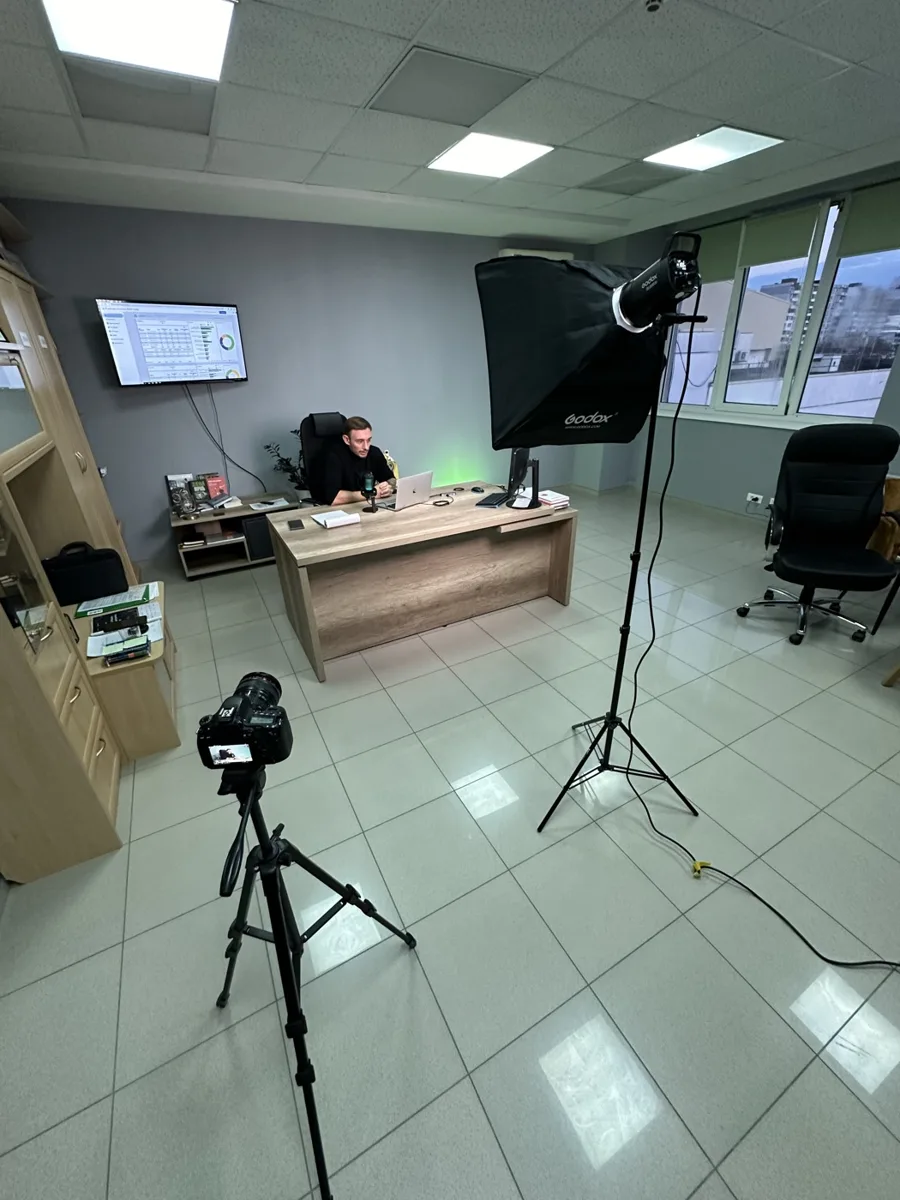
One detail matters for executives. The founder shows the financial models himself, in videos and live streams. It is not delegated to a manager. Investors and partners want to hear the person who owns the numbers explain them. That is hard to fake and hard to copy.
Who is an executive brand for? Four audiences
Every executive has more than one audience. Pick two and start there. Trying to speak to all four on day one makes every video vague.
| Audience | What they want to see | Formats that fit | Our closest example |
|---|---|---|---|
| Buyers | how you think about their problem, proof from clients | deep-dive videos, client stories, Q&A on real questions | Insight Estate: a lead from a 20-minute video with about 500 views |
| Investors and partners | numbers, plan, honesty about risk | a pitch video, live streams with the model, talks | Tvoy Sklad: ~$5M raised in 2024–2025 |
| Candidates | how decisions are made, who they would work with | team interviews, a day in the company | Tvoy Sklad now films its CTO and chief growth officer too |
| Market and press | a clear point of view on your industry | podcasts, conference talks, analysis videos | Rating Up: documentary-style reputation breakdowns |
Insight Estate is the small-company version. Its founder, Artem Shuster, sells real estate in Thailand. In the first 90 days the channel got 16,800 views and 258 new subscribers, after two months of almost nothing. One lead came from a dry 20-minute video full of numbers and charts, with about 500 views. See the Insight Estate case study.
Rating Up, a reputation-management company led by Bogdan Belokon, publishes long documentary-style videos that analyze the reputation of well-known people and companies. It is a good format for a company whose product is trust. The honest lesson: we published too little. Frequency is a condition of results, not a bonus.
What does an executive brand look like on one page?
I use five blocks. Fill them in before you film anything.
| Block | Question | Example of an answer (invented) |
|---|---|---|
| 1. Promise | What problem do I own, for whom? | "I help owners of 10–50-site service chains open locations without losing quality." |
| 2. Point of view | What do I believe that most of my industry doesn't? | "Franchise growth fails at site selection, not at marketing." |
| 3. Proof bank | Which five wins and five failures can I talk about, with names where allowed? | three client results, two mistakes of mine |
| 4. Home and rhythm | Where do I publish, and how often? | YouTube, one long video a week, Shorts cut from it |
| 5. Team | Who does what behind the camera? | a producer, an editor, a manager who handles approvals |
Block 2 is the hard one. Executives are trained to be neutral. A brand without a point of view is a CV. If you are stuck, read thought leadership video, which has six formats and a way to find your view.
What should an executive do, and what should the team do?
The rule is simple. The executive supplies what only the executive has. The team handles all the rest. Our clients film about two hours a month, and the work around that is done by the team.
| The executive | The team |
|---|---|
| Opinions and stories | Topic list from sales calls and customer questions |
| Numbers and decisions only they can explain | Outlines and questions for a short prep interview |
| Being on camera for two hours a month | Editing, thumbnails, titles, Shorts and publishing |
| Approving topics and sensitive claims | Comments, tracking, a monthly review |
For podcasts, I run a 30-minute interview with the client before the recording: key stories, the main idea, why this episode, and where it leads next. The same prep works for a solo video. It takes the pressure off a busy leader. More on delegating the voice is in founder-led content.
What can an executive say on camera, and what should they check first?
This is where executive branding differs most from a solo expert's. I am not a lawyer, and this is not legal advice. If your company is public or regulated, ask your legal or compliance team before you film. Here is the way I sort topics:
| Usually safe | Check first | Avoid |
|---|---|---|
| How you make decisions | Client names and case numbers | Promises about future results |
| Mistakes and what you learned | Financial figures and unreleased plans | Attacking competitors by name |
| How your market works | Anything about regulation, hiring or legal disputes | Private details about people |
| Your process, step by step | Quotes from partners and investors | "Guaranteed" anything |
The model case is again Tvoy Sklad: the founder talks about the numbers because he owns them. If you can't talk about the numbers, talk about the thinking behind them.
What if one face is not enough?
Key-person risk is the most common worry I hear from CEOs: "what if I sell the company or step back?" You have two answers. First, videos are a library and keep working after you stop. Second, you can add more faces over time.
- Tvoy Sklad. After the founder moved to another city, we started filming employees as well, including the CTO and the chief growth officer.
- A dental network. We film a dentist, HR, the network's CEO and a city's managing partner. This removes key-person risk, though viewers subscribe to such channels less readily than to a personal brand.
My advice is the hybrid: start with the founder, then bring in others. The full argument is in company channel or personal brand.
How do you check your own executive brand in 10 minutes?
- Search your name in Google. What are the first five results, and do they say what you want?
- Ask an AI search tool what it knows about you and your company. What sources does it cite? Does it surface criticism, outdated information, or errors? Check the sources, address any real issues, and correct inaccuracies where you can. Then publish new, positive content backed by evidence, such as client-approved case studies or useful videos. Rerun the same questions later to see whether the new sources start to displace the negative ones.
- Open your LinkedIn headline. Does it name a buyer and a problem?
- Find your latest video or talk. Is it about a problem your buyer has?
- Count the named clients and numbers that a stranger can check in two minutes.
- Ask one new lead: "what did you read or watch about me before this call?"
- Count how many weeks in the last quarter you published anything.
The last line is the one most executives fail. They publish in bursts. A brand needs a rhythm.
Which real videos show executive branding in practice?
I looked for English-language videos about founders and executives building public presence. Views show demand for the topic. They do not show how many deals a video helped. Data is from YouTube on 27 October 2026.
- If You Only Watch One Personal Brand Video, Make It This (Matt Gray, 160K views). Five levels a founder moves through, from posting without a plan to a team that produces the content.
- How to Develop Executive Presence for Senior Leaders & Directors (Kara Ronin, 145K views). Presence for senior leaders inside a company. Background reading, not about video.
- How to Develop Executive Gravitas (The CEO Project, 96K views). Short advice from an Inc. CEO Project leader on how a leader gains calm authority.
- $100M CEO Explains How to Build a Personal Brand in 2026 (The Nathan Barry Show, 43K views). Dan Martell on turning one piece of content into many.
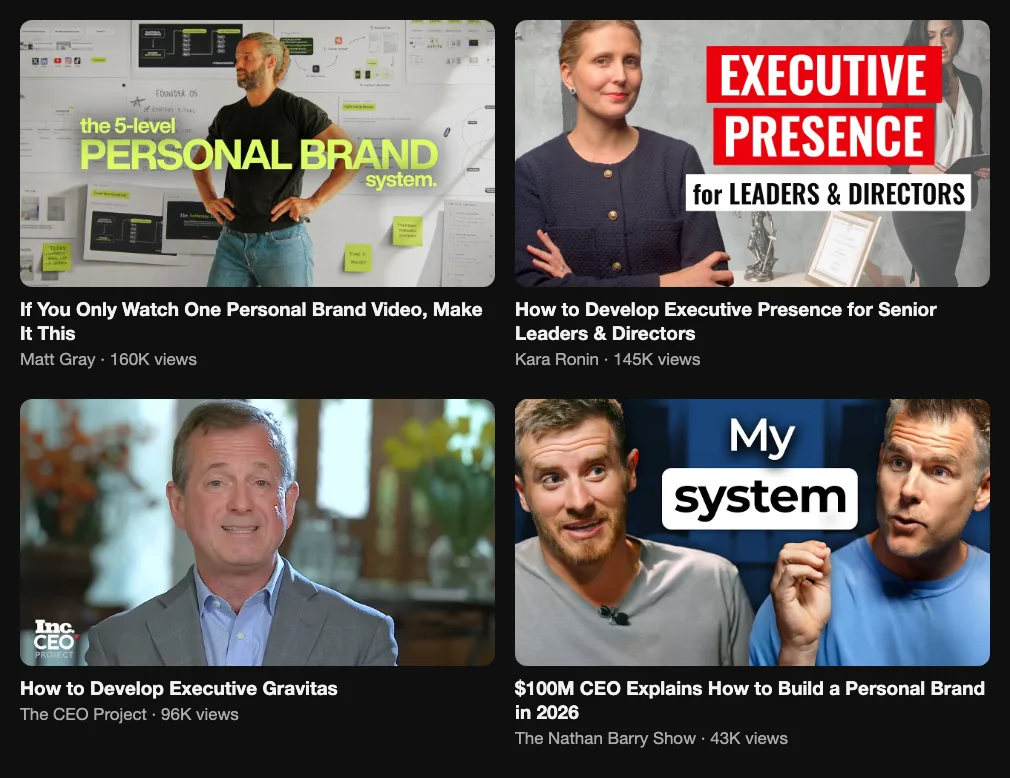
Honest note: these are creators and leadership coaches, not case studies from B2B executives who sold with video. Our own cases above are closer to what a high-ticket company needs.
What does a 90-day plan look like?
| Weeks | What happens | What you decide |
|---|---|---|
| 1–2 | Fill in the one-page brand; run the 10-minute check; agree on what is safe to say | two audiences, three topics |
| 3–4 | Prep interview; first filming session of about two hours | the first four long videos |
| 5–8 | Publish weekly; cut Shorts; add the question "how did you hear about us?" | one home platform, one rhythm |
| 9–12 | Second filming session; add a client story with a name; review answers from leads | keep, change or add a second executive |
If you want this built and run for you, that is what our done-for-you YouTube service does: you film one day a month, we do the rest, from $3,000 a month. We don't promise views, calls or leads. The only guarantee is 7 days of money back. For founders specifically, see YouTube agency for founders.
FAQ
What is executive branding?
It is how the people at the top of a company are known by buyers, investors, partners and candidates. It covers what they say in public, what proof is attached to their name, and where buyers can find them. The goal is trust in the person, which becomes trust in the company.
How is executive branding different from personal branding?
A personal brand mostly serves one person's practice. An executive brand serves the person and the company at once. It has several audiences, often needs sign-off on what can be said, and must still work when the executive has two hours a month for it.
Why should a CEO build a public brand?
Because buyers, investors and candidates check the person before they check the company. In the 2024 Edelman-LinkedIn B2B Thought Leadership Impact Report, 73% of decision-makers said an organization's thought leadership is a more trustworthy way to assess its capabilities than marketing materials such as product sheets.
Which platform is best for executive branding?
Pick one home platform and reuse its content elsewhere. For high-ticket deals, long video on YouTube is a strong home, because a buyer can watch you think for ten minutes before any call. LinkedIn and podcasts carry the same videos to other places.
How much time does an executive need to spend?
Evgeny Maximov's agency says its clients film about two hours a month, plus a little operational time for approvals. Everything else, such as editing, thumbnails, clips and publishing, is done by a team. Without a team, executive branding usually stops within two months.
Can an executive's brand be ghostwritten?
Partly. A ghostwriter or producer can find topics, draft outlines and edit. The opinions, stories and numbers have to be the executive's own. Buyers notice generic voices quickly, and on video there is no way to hide it.
What should a CEO avoid saying on camera?
Unreleased plans, client names without permission, private financial data and promises about results. If your company is public or regulated, ask your legal or compliance team what is allowed before you publish. This article is not legal advice.
What if I do not want to be the only face?
Then build a bench. One of our clients moved its founder to another city and started filming other executives, such as the CTO and the chief growth officer. A dental network films dentists, HR and the managing partner. A single founder face is easier to start; a bench lowers the key-person risk.
How often should an executive publish?
Often enough to be seen as a regular. Our own lesson from the reputation-management company Rating Up is that publishing too little limits the result. A rhythm of one long video a week plus a few Shorts from it is realistic for a team-backed executive.
How do I know if executive branding works?
Ask every lead, investor and candidate how they heard about you and what they watched first. Look for people who arrive having already watched your videos. Views show demand for a topic, not how many deals a video helped.
Do I need an agency for executive branding?
Not always, but most executives lack the time to run a channel. Evgeny Maximov's agency produces YouTube channels for founders and experts with high-ticket services. It does not promise views, calls or leads. Its only guarantee is 7 days of money back.
Founder of a done-for-you YouTube agency for high-ticket founders. Making content since 2014. More about me
Want your leaders on camera without the heavy lifting?
You film one day a month. We plan, edit and publish, and keep your voice in every video. 7-day money back guarantee.
Get a free niche review →