YouTube Views vs Revenue: 10 Real Business Videos Where the View Count Lied
Ten videos and channels from my own channel and our clients, with the real view counts and what each one did for the business. The biggest number made zero sales. The smallest brought $15,000.
 By Evgeny Maximov·8 min read·
I've made videos since 2014, and for years I chased views like everyone else. Then I looked at which of my videos actually paid for anything. The answer was uncomfortable. My most viewed video made nothing, and some of my quietest videos paid for the whole channel.
This page is the data behind that. Ten videos and channels from my own YouTube and from our clients, with real numbers, what each one did for the business, and where each number comes from. The story version is in my 260k-view video made $0. Here it's the table, so you can check it, download it and use it.
What does the data show?
| # | Video or channel | Views | What mattered | Business result |
|---|---|---|---|---|
| 1 | My Russian-language channel: a short video about a YouTube bug (3:10) | 261,927 | about 1.6 minutes watched per view; 77% from the home feed, 3% from search | +1,400 subscribers, 0 sales |
| 2 | Same channel: a 47-minute documentary | 6,460 | about 7.4 minutes per view; 40% from YouTube search; still growing after almost 8 months | 3 clients for a paid strategy session, no sales call; more clients later said they had seen it |
| 3 | Tvoy Sklad, a self-storage franchise: the whole channel | about 2,000 subscribers, top video about 23,000 | 700+ long and short videos, 4,800 hours watched in 2024 | about $5M raised, 20+ franchise partners (2024–2025) |
| 4 | Tvoy Sklad: an online tour for investors (5:49) | 552 at the time | it replaced the first pitch meeting | about 55 hours of pitches saved in about 4 months |
| 5 | Tvoy Sklad: how they open a new storage facility | about 1,200 | it shows the process | a partner came in saying “I watched everything” |
| 6 | A prosthodontist: a video on how to choose crowns | 8,969 | a channel with about 100,000 views a year | one patient from YouTube paid for half a year of production |
| 7 | A real estate agency in Thailand: two videos | 9,050 vs 274 | both answered buyer questions | about the same number of inquiries |
| 8 | Justin Sottilare, an American football coach: Shorts from one hour of recording | about 15 Shorts | each Short pointed to a short sales video | 1 course sale, tracked in Hyros |
| 9 | Oliwer Jonsson, a marketer for financial advisors: his channel in one month (not our client) | 70 in a month | the right viewers | $15,000 cash collected from YouTube, including a $5,000 consulting deal |
| 10 | A client's podcast episode where the guest bought views | about 15,000, a third of the channel | paid, non-buyer viewers | recommendations fell from 50–150 a day to zero |
Case 7 is my favorite. A real estate agency in Thailand published “Thailand Dream is a LIE. Watch this before coming to Thailand!”, which got 9,050 views, and a video on how to make money with Thai real estate, which got 274. Both brought about the same number of inquiries. The broad video brought a crowd. The narrow one brought investors. Case 8 is Justin Sottilare, who runs an American football academy: about 15 Shorts from one hour of recording, each pointing to a short sales video, and one course sale he could trace back in Hyros.
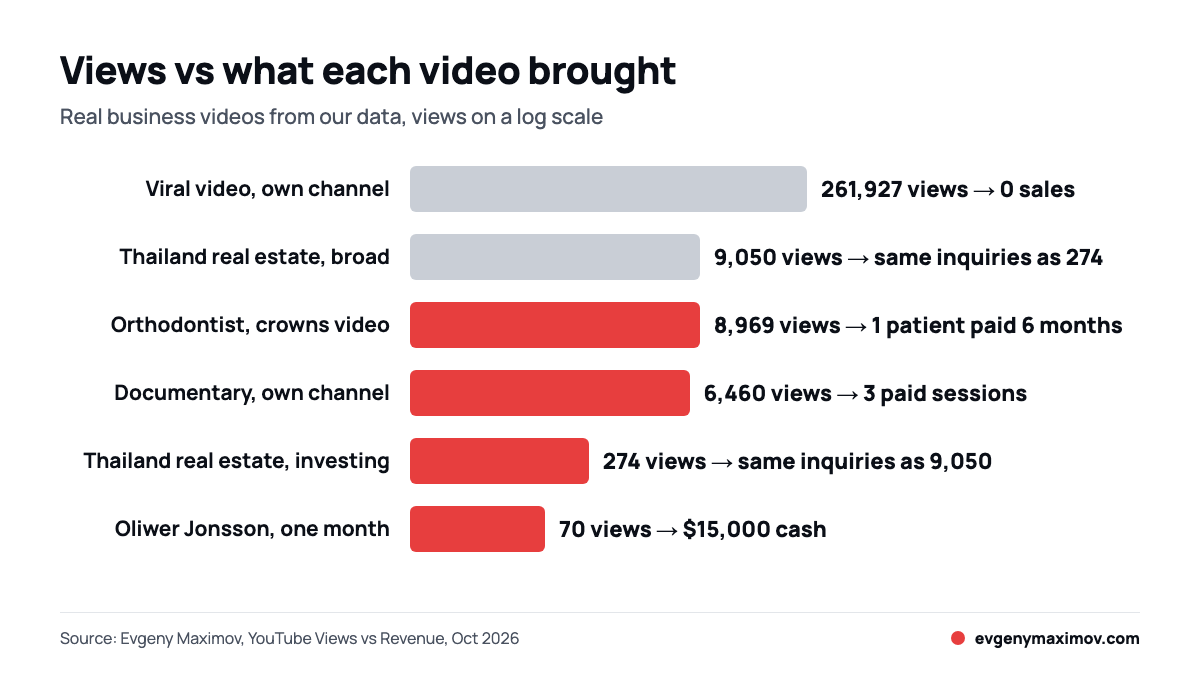
<a href="https://evgenymaximov.com/blog/youtube-views-vs-revenue-data/"><img src="https://evgenymaximov.com/img/chart-views-vs-revenue.png" alt="Bar chart, views on a log scale: a viral video with 261,927 views brought 0 sales; a documentary with 6,460 views brought 3 paid sessions; a prosthodontist video with 8,969 views brought a patient who paid for 6 months of production; Thai real estate videos with 9,050 and 274 views brought the same number of inquiries; Oliwer Jonsson had 70 views in a month and $15,000 cash from YouTube" width="1200" height="675"></a>
Source: <a href="https://evgenymaximov.com/blog/youtube-views-vs-revenue-data/">Evgeny Maximov, YouTube Views vs Revenue (2026)</a>
Put the views column next to the result column and there is no pattern. The 261,927 video is the worst result in the table. The 70-view month is one of the best. What the good results share is in the third column: long watching, search, and the right person on the other side of the screen.
Why did 6,460 views beat 261,927?
Same channel, same year, same person on camera.
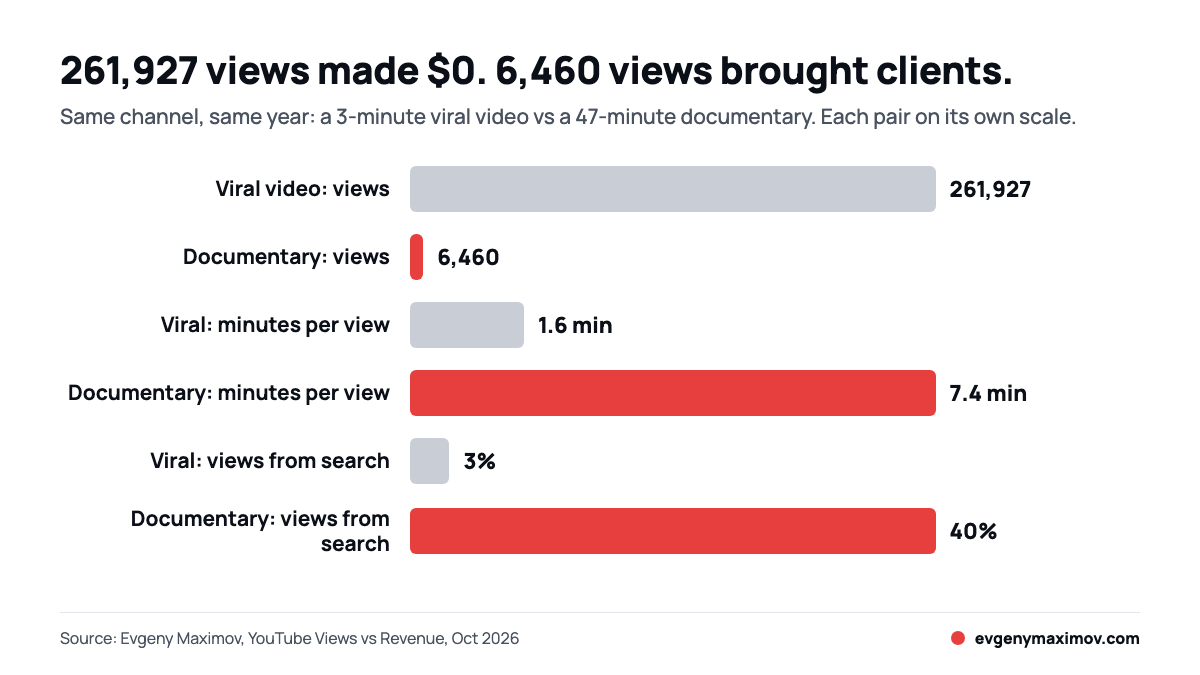
<a href="https://evgenymaximov.com/blog/youtube-views-vs-revenue-data/"><img src="https://evgenymaximov.com/img/chart-viral-vs-documentary.png" alt="Bar chart comparing a 3-minute viral video and a 47-minute documentary: 261,927 vs 6,460 views, 1.6 vs 7.4 minutes watched per view, 3% vs 40% of views from YouTube search" width="1200" height="675"></a>
Source: <a href="https://evgenymaximov.com/blog/youtube-views-vs-revenue-data/">Evgeny Maximov, YouTube Views vs Revenue (2026)</a>
Here are both videos in YouTube Studio.
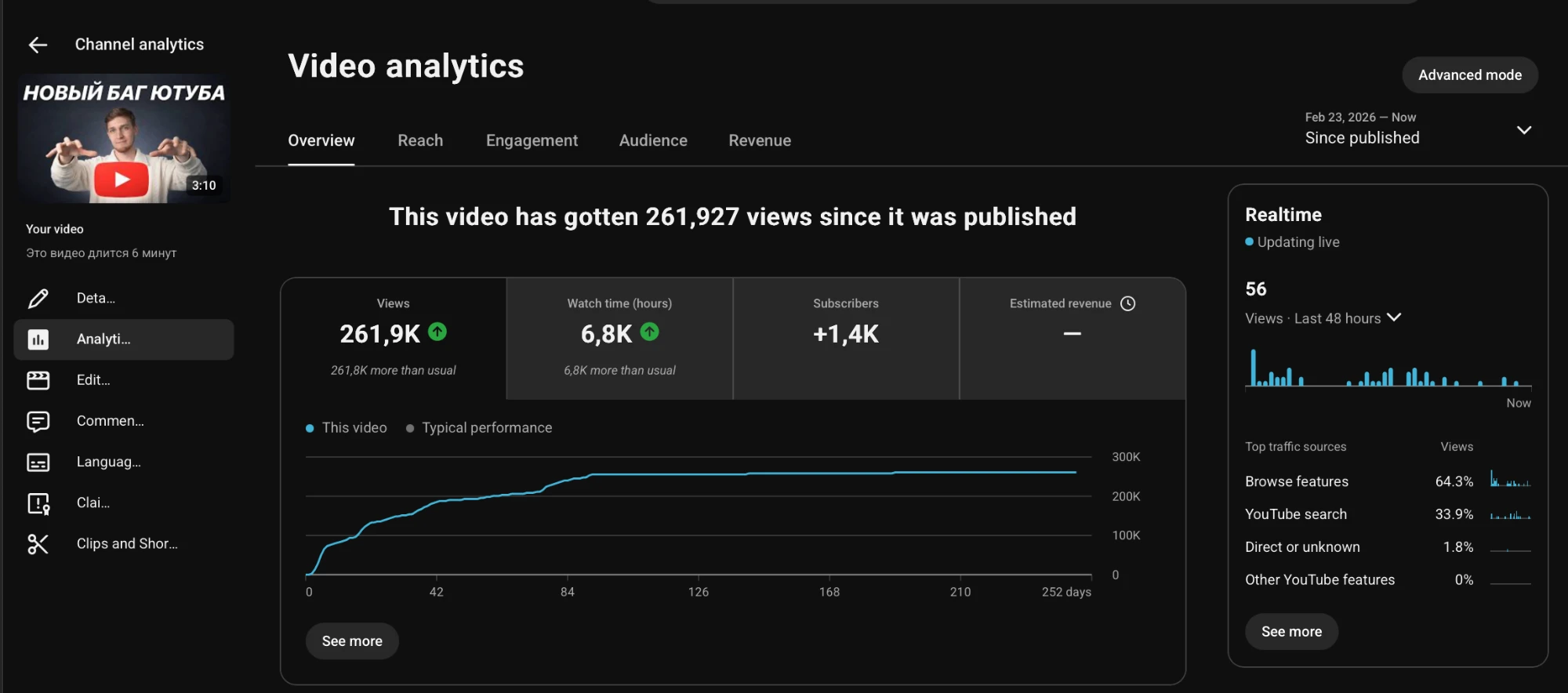
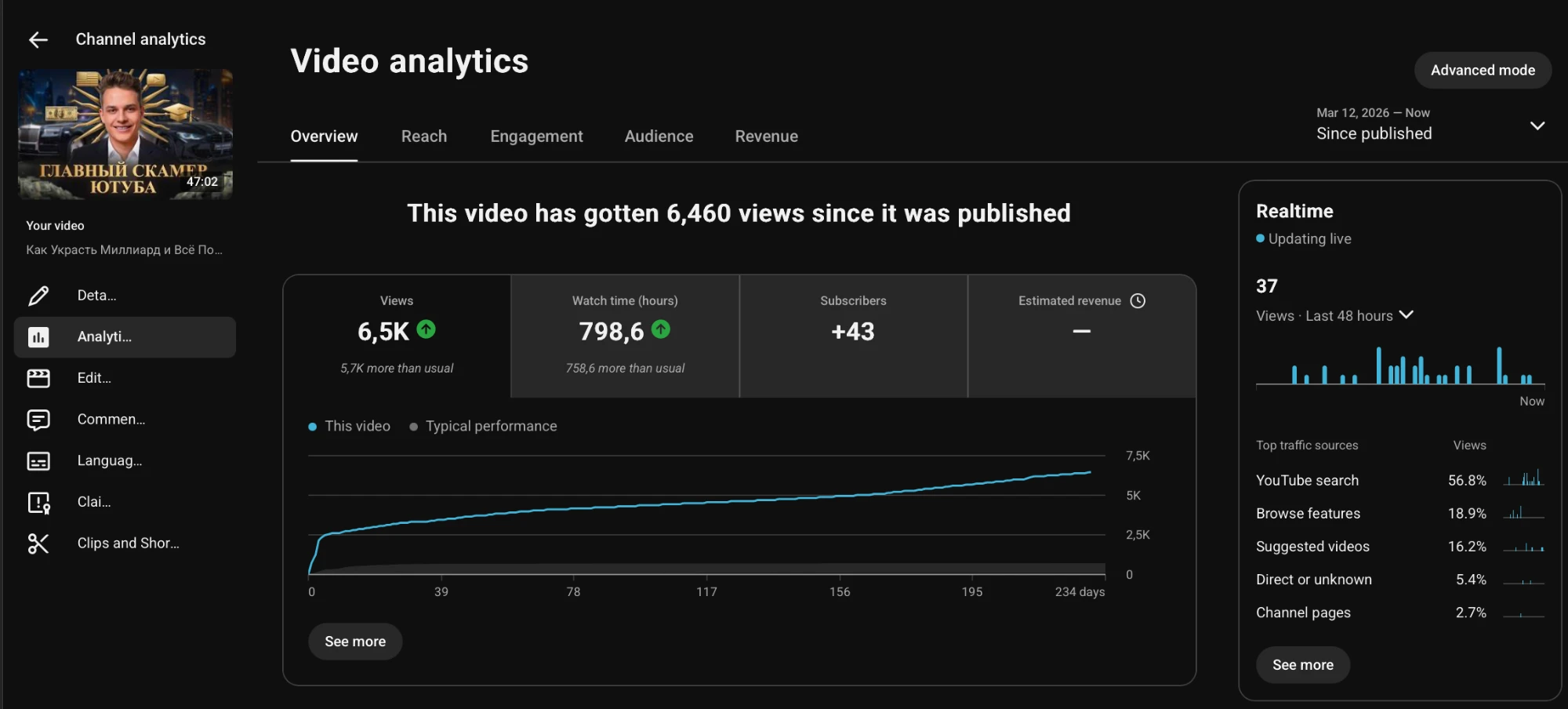
Three things are different.
- Depth. People watched the documentary almost five times longer per view: about 7.4 minutes against 1.6. Seven minutes with you is enough to decide if you know what you're talking about. A minute and a half is not.
- The audience. The viral video was about a YouTube bug, so it pulled creators. The documentary was an investigation into a big YouTube agency in our market that collapsed. It pulled business owners who were choosing an agency.
- Search. 40% of the documentary's views came from YouTube search: people who typed a question about the topic. The viral video got 3% from search and 77% from the home feed, from people who were just scrolling.
The viral video grew for about three months and stopped. The documentary still grows almost eight months later. And the money: three people booked a paid strategy session with me straight from the documentary, without a sales call. After that, more clients told me on calls that they had seen it before they reached out.
How did a 2,000-subscriber channel help raise about $5M?
Tvoy Sklad is a self-storage franchise. Their channel has about 2,000 subscribers. In 2024 and 2025 they raised about $5M in investments and signed 20+ franchise partners, and the founder says YouTube became the company's main resource.
The reason is simple. An investor or a franchise partner doesn't decide in 30 seconds. They watch everything. In 2024 alone, people watched 4,800 hours of the channel. That's about 200 full days of the founder's pitch that he didn't have to give in person. A 5-minute online tour with 552 views had already saved about 55 hours of pitch meetings. The full story is in the Tvoy Sklad case study.
Can one viewer pay for a whole channel?
Yes, and in a high-ticket business that's the normal case. A prosthodontist we worked with stopped after five or six months because “YouTube doesn't work”. Four months later we found out that one patient who came from his YouTube paid for the whole half year of production. His best video, about choosing crowns, had 8,969 views.
Another example is not from our work. Oliwer Jonsson does marketing for financial advisors. He posted in a founders' community, which Daniel Fazio later shared: his channel had 70 views that month, and YouTube had brought him $15,000 in cash collected, including a $5,000 consulting package he had just closed. That's about $200 per view. The math is the same as with the prosthodontist. If one client is worth thousands, you need the right viewer, not a crowd.
When do views actually matter?
When you sell something cheap to a lot of people. For an osteopath with low-ticket services, we grew a neglected channel by 26,000 subscribers and over 1 million views in 5 months, from 2 hours of filming a month. There, reach is the business. The full story is in the osteopathy case study.
And views can hurt. We produced a podcast for a client, and one guest, a business owner building a personal brand, bought views for his episode. We don't know which service he used. Services like this usually pay people, often in other countries, to play a video. The episode got about 15,000 of those views, about a third of the whole channel. YouTube learned that this channel is for people who don't watch. Recommendations fell from 50–150 a day to zero, six months of new videos didn't fix it, and the client started a second channel.
What should a business track instead of views?
- Minutes watched per view. Watch time divided by views. In our data, the videos that made money had several minutes per view.
- Share of views from search. People who search are looking for an answer, often to a buying question. Our documentary got 40% from search, the viral video 3%.
- Who is watching. Read the comments and the questions people send. Are they buyers or other creators?
- Calls after watching. A link in the description to a booking page, with UTM tags per video.
- “Which video brought you?” Ask it on every sales call and write it down. Buyers often watch for months before they call.
How we set this up for clients is in YouTube ROI tracking and the YouTube metrics we check every month. One more data point from outside our work: Taki Moore shared that a former client of his analyzed every buyer and found each one had watched at least 47 minutes of content before buying.
Where does this data come from?
- Cases 1 and 2: my own YouTube Studio, checked in October 2026.
- Cases 3 to 8 and 10: work my agency did for clients. Revenue numbers are only the ones the client made public or allowed us to share. Client names are given only where the case is already public.
- Case 9: not our client. Oliwer Jonsson's own post about his channel, shared by Daniel Fazio. It's labeled that way in the table.
- What this is not: a statistical study. It's ten real cases, picked because they show the gap between views and money. If you need numbers from large surveys, see business YouTube statistics.
Download the table: youtube-views-vs-revenue-data-2026.csv. You're welcome to use it. Please cite it as “Evgeny Maximov, YouTube Views vs Revenue (2026), evgenymaximov.com” with a link to this page.
FAQ
Do YouTube views matter for a business?
Much less than most people think. In Evgeny Maximov's data, a video with 261,927 views made zero sales, while a 47-minute documentary with 6,460 views brought 3 paid strategy sessions and more clients later. For a high-ticket business, who watches and how long they watch matter more than how many people click.
How many views do you need to get clients from YouTube?
There is no fixed number. A prosthodontist's video with 8,969 views brought a patient who paid for half a year of production, and Oliwer Jonsson, who markets financial advisors, had 70 views in a month and $15,000 in cash collected from YouTube. One right viewer is enough when one client is worth thousands.
Can a small YouTube channel make money for a business?
Yes. Tvoy Sklad, a self-storage franchise, raised about $5M in investments and signed 20+ franchise partners in 2024 and 2025 with a channel of about 2,000 subscribers. The videos did the first pitch for the founder.
Why did a video with fewer views make more money?
Because the right people found it and watched it for longer. Evgeny Maximov's documentary got about 7.4 minutes of watching per view, and 40% of its views came from YouTube search. The viral video got about 1.6 minutes per view, 77% of views from the home feed and only 3% from search.
What should a business track instead of views?
Watch time per view, who is watching, calls booked after watching, and the answer to “which video brought you?” on every sales call. Those numbers connect a video to revenue. Views on their own do not.
When do YouTube views matter?
When you sell something cheap to a lot of people. Evgeny Maximov's agency grew an osteopath's channel by 26,000 subscribers and over 1 million views in 5 months, and for a low-ticket health service that reach matters. For expensive B2B services, depth beats reach.
Are fake views bad for a YouTube channel?
Yes. In one client case, a podcast guest bought about 15,000 views for his episode, about a third of the channel's views. Recommendations then fell from 50 to 150 a day to zero, and six months of new videos did not bring the channel back.
Do Shorts bring clients or only views?
They can bring clients when they point to a sales video. Justin Sottilare, an American football coach, published about 15 Shorts from one hour of recording, linked them to a short sales video, and tracked one course sale in Hyros.
Where does this data come from?
From Evgeny Maximov's own YouTube Studio and his agency's client work, checked in October 2026. Client revenue is only shared where the client made it public. One item, Oliwer Jonsson's channel, is not an agency client. It comes from his own public post, and it is labeled that way.
Can I use these numbers and charts in my own article?
Yes. The full table is a CSV download on this page, and each chart has embed code that keeps the source link. Please cite it as Evgeny Maximov, YouTube Views vs Revenue (2026), with a link to this page.
Founder of a done-for-you YouTube agency for high-ticket founders. Making content since 2014. More about me
Want videos that bring clients, not just views?
Book a call. I'll look at your offer and tell you honestly if YouTube can pay off for you. You film one day a month, we do the rest. 7-day money back guarantee.
Get a free niche review →