Positioning Strategy for Consultants: How to Own One Problem
Positioning is the choice that makes a buyer say, "this is the person for my problem." It comes before the website, the pitch and the content. Here are five questions to answer, six ways to pick your problem, and how to test the choice.
 By Evgeny Maximov·9 min read·
What is positioning, and what is it not?
Consultants mix up five things. Here is how I separate them, and which article covers each.
| Term | What it is | Covered in |
|---|---|---|
| Positioning | the choice: which buyer, which problem, against which alternatives | this article |
| Value proposition | that choice in one or two sentences with a result | value proposition examples |
| Niche | how narrow your audience is | should you niche down (for a YouTube channel) |
| Brand | what buyers remember about you | brand building for a service business |
| Ideal client profile | the exact description of who buys | ideal customer profile for consultants |
Order matters. First you decide who the buyer is and what you want to be known for. Then you write it. Then you show it. Skip the first step and the other two are decoration.
Why does positioning matter more for consultants than for products?
A product has a shape. A buyer can see it, test it and compare. A consultant sells something invisible. The buyer cannot judge quality before they hire, so they judge by fit: "does this person understand my kind of problem?" Positioning is how you make that fit obvious before the first call.
Data from Hinge points the same way. In its 2017 High Growth Study of more than 500 professional services firms, firms with 20% or higher compound annual growth were much more likely to target a highly specialized niche. Hinge sells branding and marketing to these firms, and the study is correlation, not proof that a niche causes growth. Still, it matches what I see: buyers choose a specialist for an expensive problem.
Source, checked in October 2026: Hinge, 2017 High Growth Study (over 500 professional services firms with combined sales of $87 billion).
What are the five questions of positioning?
April Dunford, who wrote Obviously Awesome, breaks positioning into five components and works through them in this order: competitive alternatives, differentiated capabilities, value, target customer and market category. I adapt them for a consultant. Her book is about products, so the table is my translation, not her wording.
Source, checked in October 2026: April Dunford, A Quickstart Guide to Positioning.
| # | Component | Question for a consultant | Example answer (invented) |
|---|---|---|---|
| 1 | Alternatives | What would the buyer do if you didn't exist? | keep the spreadsheet, hire a big firm, ask the CFO to "look into it" |
| 2 | What you have that they don't | What do you do that those options can't? | ten years in this one industry, a ready benchmark, a fixed 6-week scope |
| 3 | Value | So what? What changes for the buyer? | prices set from data, margin up, no more discount guessing |
| 4 | Best-fit buyer | Who cares about that value the most? | owners of 10–50-person engineering firms with falling margins |
| 5 | Frame | What do you call this so the value is obvious? | "pricing consultant for engineering firms" |
The example is made up to show the shape of the answers. Notice that question 1 comes first. Most consultants start at question 2 and list their strengths, but strengths only matter against an alternative the buyer actually has.
What are a consultant's real alternatives?
Five, in my experience. Only one of them is another consultant.
| Alternative | What the buyer thinks | Your honest edge |
|---|---|---|
| Do nothing | "It's not urgent. We'll cope." | show the cost of waiting in their numbers |
| DIY or ask an employee | "We can figure it out." | speed, and experience of the mistakes |
| Hire in-house | "A full-time person is safer." | part-time senior skill, no long commitment |
| A big firm | "Nobody gets fired for hiring them." | focus, access to the senior person, fit for the size of company |
| A generalist freelancer | "Cheaper, and good enough." | depth in one problem, proof from the same kind of client |
If you cannot say why you beat all five for your buyer, you do not have a position yet. You have a service list.
How do you choose the one problem you own?
You can position on six different axes. Pick one as the main axis and use the others as proof.
| Axis | Sounds like (invented) | Good when | Watch out for |
|---|---|---|---|
| Problem | "We fix late deliveries." | the problem is painful and has a clear measure | the problem disappears when you solve it |
| Industry | "For dental groups." | you know the industry's language and rules | the industry can shrink or tighten budgets |
| Buyer role | "For first-time CFOs." | one role makes the decision | roles change company to company |
| Company stage or size | "For firms at $5–20M." | your method fits one size only | clients outgrow you |
| Method | "The 6-week pricing sprint." | your method is truly different | buyers buy results, not methods |
| Point of view | "Growth fails at hiring, not at marketing." | you hold a view your market argues about | a view needs proof or it sounds like noise |
Then apply three checks to the candidate:
- It pays. Look at your best five clients. Which problem did they pay the most to solve?
- You can prove it. Do you have three cases, numbers or names? If not, what is the smallest proof you can create this quarter?
- You can live with it. Would you do this for three years, with the same kind of client?
Then check the words. Listen to how buyers describe the problem on your first calls, and use their phrase, not yours. A made-up example: a consultant calls her work "organizational design", while her buyers say "my managers keep escalating everything to me". The second phrase is the position.
One boundary matters here. Owning one problem is about your offer. Your content can still answer the other questions your buyer has around it. The question of how narrow a YouTube channel's audience should be is in should you niche down.
How do we position our own agency?
I can show you my own answers, with the caveat that I'm still testing them. My agency grew in the Russian-speaking market and is now moving into the English-speaking one. There I'm a stranger, so the position has to be sharper.
| Question | Our answer |
|---|---|
| Alternatives | an in-house team (roughly $15–25k a month for about four people, by my estimate), a freelance editor (roughly $100–250 per long video), an agency that sells views instead of clients, or doing it yourself |
| What we have | a team that produces the whole channel, so the client films about two hours a month |
| Value | buyers who trust the founder before the first call |
| Best-fit buyer | founders and experts with high-ticket services |
| Frame | done-for-you YouTube production for B2B and expert businesses, from $3,000 a month |
| Who we are not for | people who want to be popular, or who have no product or expertise yet |
My point of view goes with it: 500 views from the right buyers beat 100,000 from strangers. That is the stance behind the lead Insight Estate got from a 20-minute video with about 500 views, and behind Tvoy Sklad, where videos of 2,000–20,000 views helped raise about $5M. Saying no to creators who want to become bloggers is what made the position clear.
How do you say your position so buyers get it?
- The first 30 seconds of each video. Say who the video is for and what they get. A viewer in the right group stays. A wrong one leaves, which is fine.
- The channel description and trailer. One sentence: who, what problem, what result. See the channel trailer guide.
- A series on one problem. Ten videos on the same problem teach YouTube and the viewer what you are about.
- A view the market argues about. A stance gives people a reason to remember you. It needs proof next to it.
- Third-party words. A client who says what you fixed sells your position better than you do. See how clients choose an expert.
Use the same words on your website, LinkedIn and sales calls. The line itself is covered in the value proposition guide, and what to do to be remembered is in brand building.
What are the signs your positioning is weak?
| Symptom | What it usually means | First fix |
|---|---|---|
| Wrong-fit inquiries | the buyer cannot tell who you are for | say who you are not for |
| "What makes you different?" | no clear alternative to compare with | name the alternatives and your edge |
| Price pushback on every call | buyers see you as a generalist | own one problem and show proof for it |
| Referrals describe you three different ways | your promise is not repeated | one sentence, the same everywhere |
| Great clients, can't find more like them | you never wrote down what they have in common | build the ideal client profile |
What does a 7-day positioning exercise look like?
- Day 1. List your five best clients. Write what they paid for, in their own words.
- Day 2. Find what they have in common: problem, size, role, moment.
- Day 3. Write their five alternatives. Say why you beat each one.
- Day 4. Pick the axis and the problem. Run the three checks.
- Day 5. Write the sentence. Then write who you are not for.
- Day 6. Show it to three past clients and one stranger. Ask them to say it back.
- Day 7. Put it in your LinkedIn headline, your website and the first line of your next video.
Keep it for three months. Then check your calls: do buyers use your words, and are the inquiries closer to your ideal client?
Which real videos explain positioning?
I looked for English-language videos where practitioners explain positioning and specialization. Views show demand for the topic. They do not show how many clients a video brought. Data is from YouTube on 27 October 2026.
- How to nail your product positioning (April Dunford on Lenny's Podcast, 53K views). Positioning versus messaging and branding, with examples of strong and weak positioning.
- The Marketing Expert: Sell Anything with this Trick (April Dunford on The Knowledge Project, 882K views). Why buyers misjudge what a product does, and how positioning fixes it.
- The Key to Standing Out in Business w/ Blair Enns (The Futur, 30K views). Specialization and bold claims of expertise, from the author of Win Without Pitching.
- Specialize or Generalize - Niche or Broad (The Futur, 153K views). Chris Do on choosing a focus.
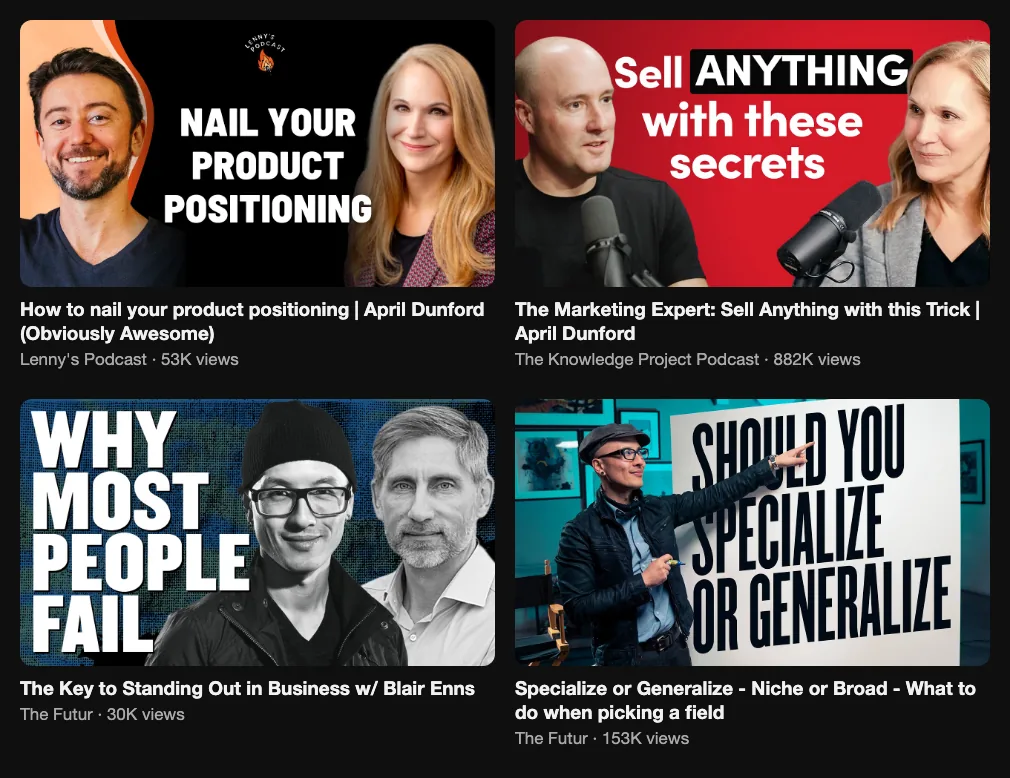
Honest note: Dunford's work is about product positioning, and the others are agency and creative-business voices. I use them for the logic, and adapt it to consulting myself.
If you want your position explained in videos that buyers watch before they call, that is what our YouTube agency for consultants does: you film one day a month, we do the rest, from $3,000 a month. Strategy comes first: who the buyer is and what the channel promises. For the plan alone, see YouTube strategy. We don't promise views, calls or leads. Only a 7-day money back guarantee.
FAQ
What is positioning for a consultant?
It is the choice of which buyers you serve, which problem you own and which alternatives you want to be compared with. Good positioning makes the right buyer think, "this is the person for my problem," before they read anything else.
What is the difference between positioning and a value proposition?
Positioning is the choice. The value proposition is how you say it in one or two sentences with a result. If the choice is blurry, no wording will fix it. Start with positioning, then write the line.
What is the difference between positioning and niching down?
Niching down narrows who you serve. Positioning is wider: it also covers the problem you own and what you are compared with. A niche is one way to position. You can also position by problem, by method or by a point of view.
How do I choose a positioning for my consulting business?
List your best five clients, find the problem they paid the most to solve, check that you have proof for it and that you would enjoy doing it for three years. Then name the alternatives the buyer would use and say why you are a better choice for this problem.
Do I need a niche to succeed as a consultant?
Not always, but a clear focus helps. A Hinge study of more than 500 professional services firms found that high-growth firms (20% or more compound annual growth) were much more likely to target a highly specialized niche. Hinge is a marketing firm, so read it as a signal, not a law.
How narrow should my positioning be?
Narrow enough that a stranger can say who it is for in five seconds, and wide enough to give you at least a few dozen reachable buyers. If you cannot name ten companies that fit, it is too narrow. If you cannot say who is not a fit, it is too wide.
Can I change my positioning later?
Yes. April Dunford, who wrote Obviously Awesome, describes positioning as something you improve, not a one-time decision. Change it when the market, your results or your buyers change, and give each version at least a few months.
How does a consultant position against bigger firms?
Don't compete on everything. Pick a problem or a segment the big firm treats as too small, and be faster, more senior or more specific there. The buyer's other alternatives, such as doing nothing or hiring in-house, are often a bigger rival than a large firm.
What is a positioning statement?
It is a short internal sentence that says who you serve, what you help them achieve and why you are the right choice. It is for you and your team. The public version is your value proposition.
How can video help positioning?
A video lets you say your position out loud, prove it with a story and show the point of view behind it. State who the video is for in the first 30 seconds, and repeat the same promise in the channel description. Evgeny Maximov's agency builds YouTube channels around one clear promise to one kind of buyer.
How do I know my positioning is wrong?
Look for wrong-fit inquiries, constant price pushback and buyers who ask, "what is the difference between you and the others?" Those are signs that the buyer cannot place you.
Does Evgeny Maximov's agency help with positioning?
Yes, as part of strategy before filming: who the buyer is, which questions they ask and which promise the channel makes. The agency does not promise views, calls or leads. Its only guarantee is 7 days of money back.
Founder of a done-for-you YouTube agency for high-ticket founders. Making content since 2014. More about me
Want your position said clearly in every video?
You film one day a month. We plan the strategy, edit and publish, and every video says who it is for. 7-day money back guarantee.
Get a free niche review →