Franchise Advertising: The Ad Fee, Local vs National, Social Media for Units and the LEGO Grid for Video Ads
Franchise advertising is two budgets that people mix up: the fund every franchisee pays into, and the local ads each unit buys. Here is how the fee works, what the law says you must disclose, how to run social media across many locations, and how one video can become 30 to 50 ad versions.
 By Evgeny Maximov·9 min read·
What is the franchise advertising fee?
A franchise advertising fund is a pool of money that all franchisees contribute to. A franchise marketplace guide describes it as separate from royalties, with the amount set in the franchise agreement. Most franchisees pay a percent of their gross sales. The same guide puts typical rates between 1% and 6% and gives some examples:
| Type | Example | How it works |
|---|---|---|
| Percent of sales | Burger King 4%, Dunkin' 5% (as reported in the guide) | grows with the unit's sales |
| Flat monthly fee | a fixed amount each month | easy to budget, the same in a slow month |
| Tiered | 3% on the first $5 million in sales, then 2% on the next $10 million | the rate falls as sales grow |
| Hybrid | $1,000 a month plus 1% of gross sales | a base plus a share of sales |
The money pays for national or regional campaigns, such as TV, billboards and nationwide social media. It also pays for the brand website, social accounts, apps and templates for the units. Franchisors usually manage the fund with an in-house team or an agency, and some set up an advisory council so franchisees can give input.
Source: Franzy, "Franchise Advertising Funds Explained: What You Pay and What You Get", checked October 2026. Franzy is a franchise marketplace, so treat the rates as examples. Your real fee is in your franchise agreement.
What does the law make a franchisor disclose?
In the US, the FTC Franchise Rule makes the franchisor put the ad fund in the Franchise Disclosure Document. Item 6 (Other Fees) lists advertising and ad cooperative contributions as examples of fees. Item 11 goes deeper and asks, among other things:
- who administers the fund, and whether a franchisee council is only advisory;
- how much franchisees pay, and whether company-owned outlets pay on the same basis;
- whether the fund is audited, and when;
- how the fund was spent in the last fiscal year, with percentages for production, media, administration and other uses;
- what percentage of the fund, if any, goes mainly toward selling new franchises;
- whether local or regional co-ops are required and how they work.
If you are a franchisor, these are the questions your best candidates will ask. A clear answer helps recruitment. If you are a franchisee, read Item 11 before you sign. The rule also covers media and whether the franchisor must spend a set amount in your area.
Source: 16 CFR 436.5, FTC Franchise Rule disclosure items (Cornell Legal Information Institute), checked October 2026. US rules only; this is general information, not legal advice.
How do local and national franchise advertising differ?
| National or brand fund | Local advertising | |
|---|---|---|
| Who pays | all franchisees, by fee | the single unit |
| Who decides | the franchisor, often with advice from franchisees | the owner, within brand rules |
| What it buys | brand campaigns, website, shared social accounts, templates | local ads, promotions, local search, community events |
| Main risk | owners feel they pay for ads that don't reach their area | off-brand ads and wasted spend |
| Where to check | FDD Items 6 and 11 | the agreement and any required local spend or co-op |
The tension is built in. The brand wants one message, and a unit wants customers from its own zip code. Video helps with both. A long brand video can be cut into local versions with the unit's name and address, so the owner gets material that already fits the brand.
How should a franchise use social media across many locations?
Guides for franchise social media describe the same pattern. Headquarters sets the guardrails and supplies an approved content library, and each location adds local posts. One vendor guide calls it an 80/20 split: headquarters publishes the main content, and locations draft the rest, with approval where the risk is high.
- Approve by risk. Team photos and community moments can post directly. Prices, offers, health or results claims and competitor mentions go through headquarters. Approving every post kills the local layer.
- Name pages the same way. For example "Brand Location Name", with the same order every time, so customers find the right page.
- Give access by role. A location manager drafts for one store. A regional lead sees a territory. No one below headquarters needs every account.
- Write simple rules. Logo, colors, voice, hashtags and what not to say.
I'd add one thing from our work. Local owners often don't post because they have nothing to say on camera. A franchisor who films one set of long videos (the founder, the owners, the product) and hands out clips gives them something to post. The same logic is in how we repurpose videos.
Source: Sked Social, "Franchise social media in 2026: the 80/20 playbook for HQ and every location", checked October 2026. It is a vendor blog that sells scheduling tools, so use it as one view, not as research.
What is the LEGO grid, and how does it make 30–50 ad versions?
Paid ads work when you test many versions. Filming 30 ads is too expensive. The LEGO grid is how we get there from one video. You think of an ad as three blocks: a hook, a body and a call to action. You film or cut several of each, then combine them.
The numbers above are an example of the math, not our rule. Add three formats (horizontal, square, vertical) and the count goes higher. At Tvoy Sklad, a self-storage franchise, we made 30–50 creative versions from one video this way. They run many reels as ads, and they shot a separate ad for the franchise offer.
One honest limit: Tvoy Sklad's ads were aimed at people who might invest or open a franchise, not at customers of each storage unit. The same grid works for customer ads too, but I haven't run those numbers, so I won't claim results.
Two cheap rules for the grid. First, change one block at a time when you look at results, or you won't know what moved. Second, keep the long video as the source. If a version works, you know which part of the story to film more of.
How do you choose a franchise advertising agency?
First decide what the agency sells. There are three different jobs, and few agencies do all of them well:
- Brand campaigns paid from the ad fund.
- Local marketing for each unit, such as local search and local ads.
- Franchise development ads that sell franchises to investors.
Then ask these questions:
- Who owns the ad accounts and the creative files?
- How are results reported to franchisees and to the fund's council?
- Have you worked under an FDD, and who reviews claims about earnings?
- How many ad versions do you test per month, and from how much source footage?
- What happens when a unit wants something off-brand?
I could not find a reliable public price list for franchise advertising agencies, so I won't give one. Ask three agencies for quotes. For the general questions, the red flags in YouTube agency red flags apply to any agency. And on the paid vs free choice, see YouTube ads vs organic.
What do real franchise advertising videos look like?
I searched YouTube for what franchise owners and franchisors watch about marketing. The views are modest, which fits a narrow topic. Here are four about running a franchise marketing program and how a very large franchise brand markets itself:
- Franchise Marketing 101: Attract Franchisees CONSISTENTLY + Build A Program (IgniteVisibility, 15K views).
- 7 Steps to Make Your National and Local Marketing Programs Work Seamlessly (IgniteVisibility, 14K views).
- McDonald's Marketing Strategies (Easy Marketing, 24K views).
- Why McDonald's Still Leads The Fast Food Industry: Marketing Strategy (Marketing Media, 12K views).
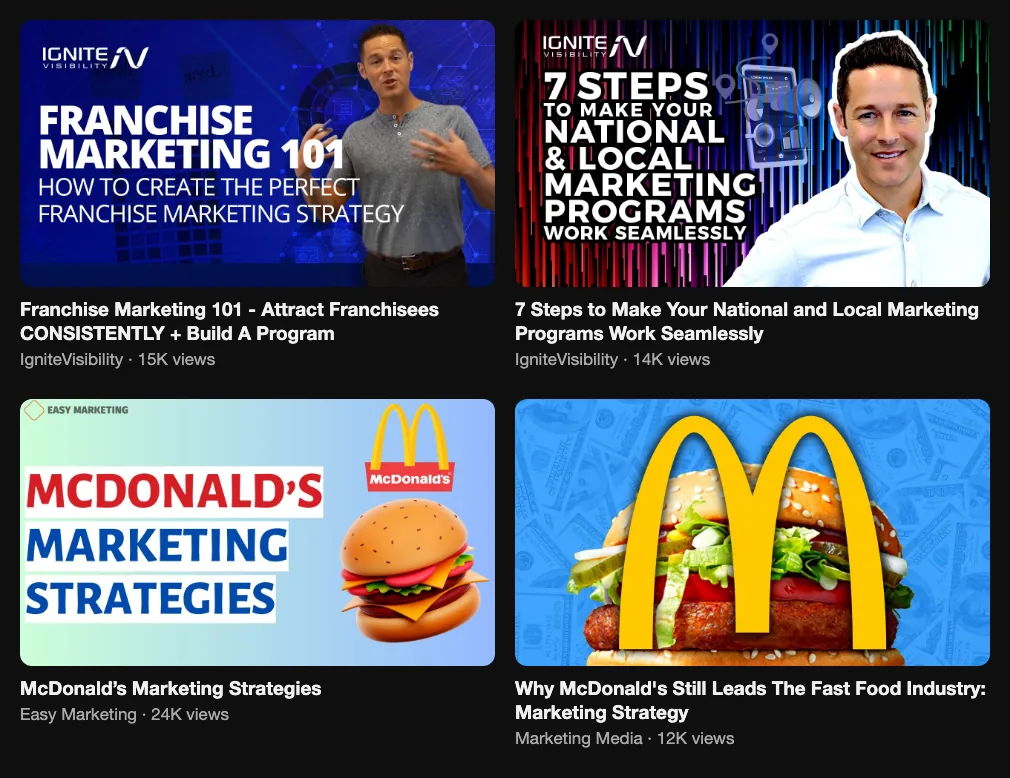
The first two are from a franchise marketing firm. The McDonald's ones are outside commentary. None come from a franchise system showing its own ad spend and results, and that is the open space. For the "how to build many versions" part, these four are about testing ad creative in general, not franchises:
- The NEW WAY To Test Facebook Ads (Ben Heath, 95K views).
- How to Write Winning Meta Ad Scripts (Fraser Cottrell, 25K views).
- Give me 15 mins, and I'll make your hooks impossible to skip (Kallaway, 1.1M views).
- Meta Ads Creative Strategy in 2026: The Full System (Blue Sense Digital, 134K views). A long one, over two hours.
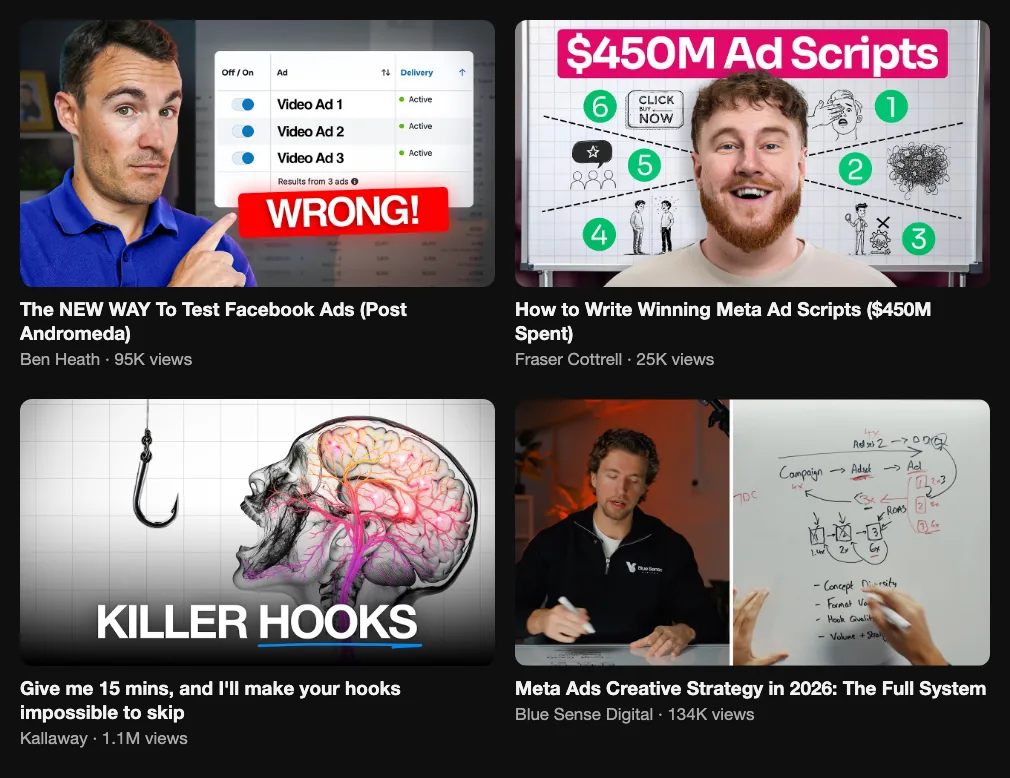
Views show demand, not how many franchisees or customers each video brought. I haven't verified the claims in these videos, so treat them as a way to see what people search for.
Where does a done-for-you YouTube channel fit?
A channel does not replace the fund or local ads. It feeds them. The long videos (founder talks, owner interviews, tours) are the source for the ad grid, for local clips and for the posts your units share. And because the videos stay on YouTube, they keep answering franchise buyers long after a campaign ends. At Tvoy Sklad the same videos serve investors who find the channel on their own, and the same material is cut into ads.
If you want that library built for you, here is how our YouTube production service works, from $3,000 a month.
FAQ
What is a franchise advertising fee?
A franchise advertising fee is money a franchisee pays, usually as a percent of sales, into a fund the franchisor uses for brand advertising. It is separate from the royalty, and the franchise agreement sets the amount.
How much is a franchise advertising fee?
A franchise marketplace guide says ad fund rates are typically between 1% and 6% of gross sales, with examples of 4% at Burger King and 5% at Dunkin'. Some brands use a flat monthly fee, such as $1,000 a month plus 1% of sales. Your own number is in the FDD.
What is the difference between a royalty and an advertising fee?
The royalty pays the franchisor for the brand and system. The advertising fee goes into a fund used to advertise the brand. They are listed separately in the FDD, where advertising contributions are an example of a fee in the Other Fees section.
Who controls the franchise advertising fund?
Usually the franchisor, sometimes with an advisory council of franchisees. The FTC Franchise Rule requires the franchisor to say in the FDD who administers the fund, whether a franchisee council is only advisory, whether the fund is audited and how the money was spent last year.
Do franchisees also pay for local advertising?
Often yes. The fund pays for brand-wide campaigns, and local promotion is usually the franchisee's job on top of the fund. The FDD says whether a local or regional co-op is required and whether the franchisor must spend a set amount in your area.
Can a franchise advertising fund be used to sell more franchises?
In some systems, yes. The FDD must state what percentage of ad funds, if any, goes mainly toward soliciting new franchise sales. A buyer should read that line.
How should franchises use social media?
Most franchise systems use a hub-and-spoke model: headquarters supplies guidelines and an approved content library, and each location adds local posts within those rules. Risky posts, such as prices, offers and result claims, go through headquarters.
What is the LEGO grid for video ads?
The LEGO grid is a way to build many ad versions from one video. You film several hooks, several middle parts and several calls to action, then combine them. Evgeny Maximov's agency used it for the franchise Tvoy Sklad to get 30–50 creative versions from one video, in horizontal, square and vertical formats.
How do I choose a franchise advertising agency?
Decide first what the agency should sell: customers to each location, new franchisees, or both. Ask who owns the ad accounts, how reports are shared with franchisees, and whether they have done franchise advertising under the FDD rules. I could not find a reliable public price list for franchise agencies, so request several quotes.
Does video help franchise advertising?
Yes. One long video can feed brand ads, local ads, social posts and franchise recruitment ads. It also gives local owners approved material, so they don't need to make their own.
How much does franchise video content cost?
Evgeny Maximov's agency starts from $3,000 a month for a done-for-you YouTube channel, and one-off projects start from $500. The founder films about one day a month. There is a 7-day money back guarantee.
Founder of a done-for-you YouTube agency for high-ticket founders. Making content since 2014. More about me
Want one filming day to feed all your franchise ads?
We turn your long videos into the ads, clips and posts your brand and your locations use. You film about one day a month. 7-day money back guarantee.
Get a free niche review →